A bulk order 1 of custom pickleball paddles can go wrong fast. I have watched buyers lose thousands on paddles they never sample-tested. On our Dongguan production line, we help prevent that.
Request samples from your supplier once you have finalized your paddle shape, core material, and face surface—and always before committing to a bulk order. Sample even earlier when you are validating a new supplier, testing a new construction, or launching a performance-sensitive brand.
That single decision point saves more money than any price negotiation. In this article, I will walk you through how many samples to order, what to inspect, how long sampling takes, and who should pay for it. I will also share what we see from real buyers every week.
How many sample paddles should I request before placing a bulk order?
Last month, a brand owner in the Philippines messaged us on WhatsApp with one blunt question: how many samples do I actually need before I commit?
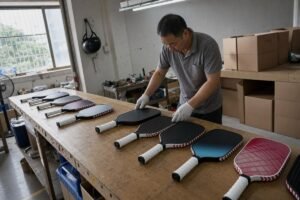
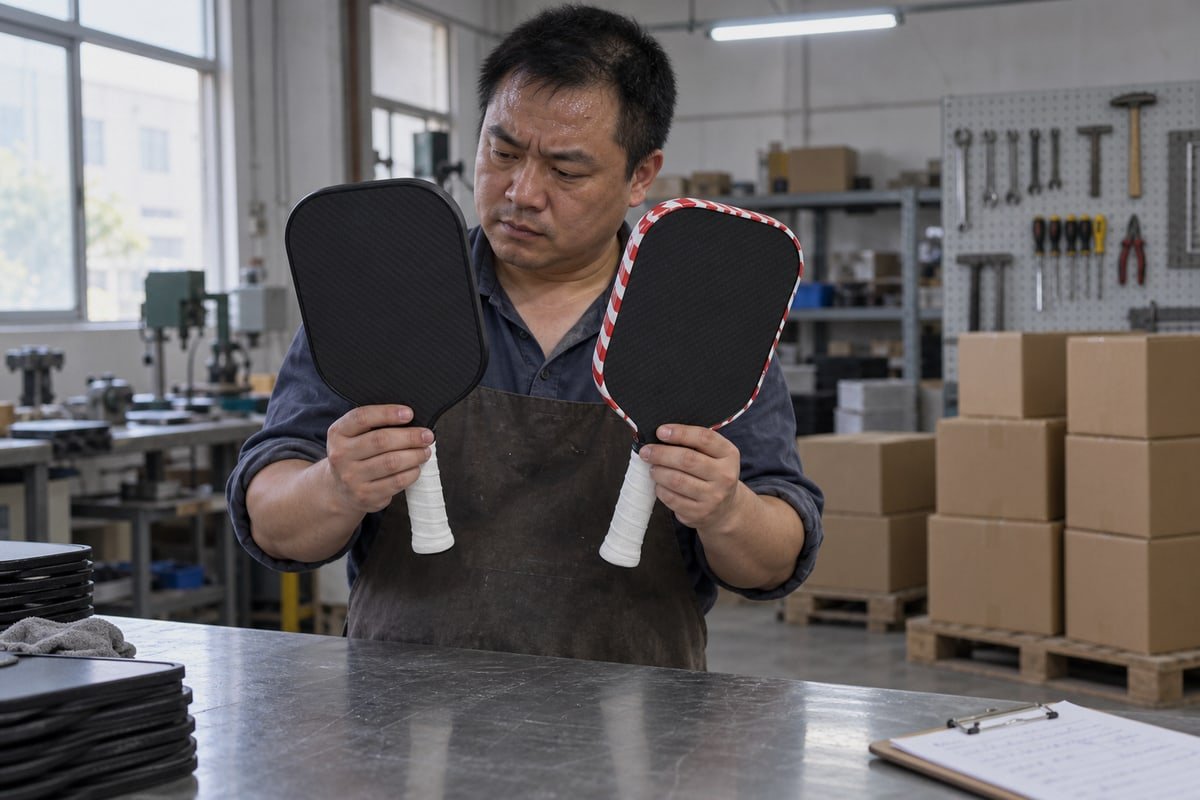
Request two to four samples per shortlisted supplier: one blank paddle for construction and destructive testing, and one fully branded prototype for artwork and feel. If you are comparing two or three manufacturers, order from each, then request a golden sample before mass production begins.
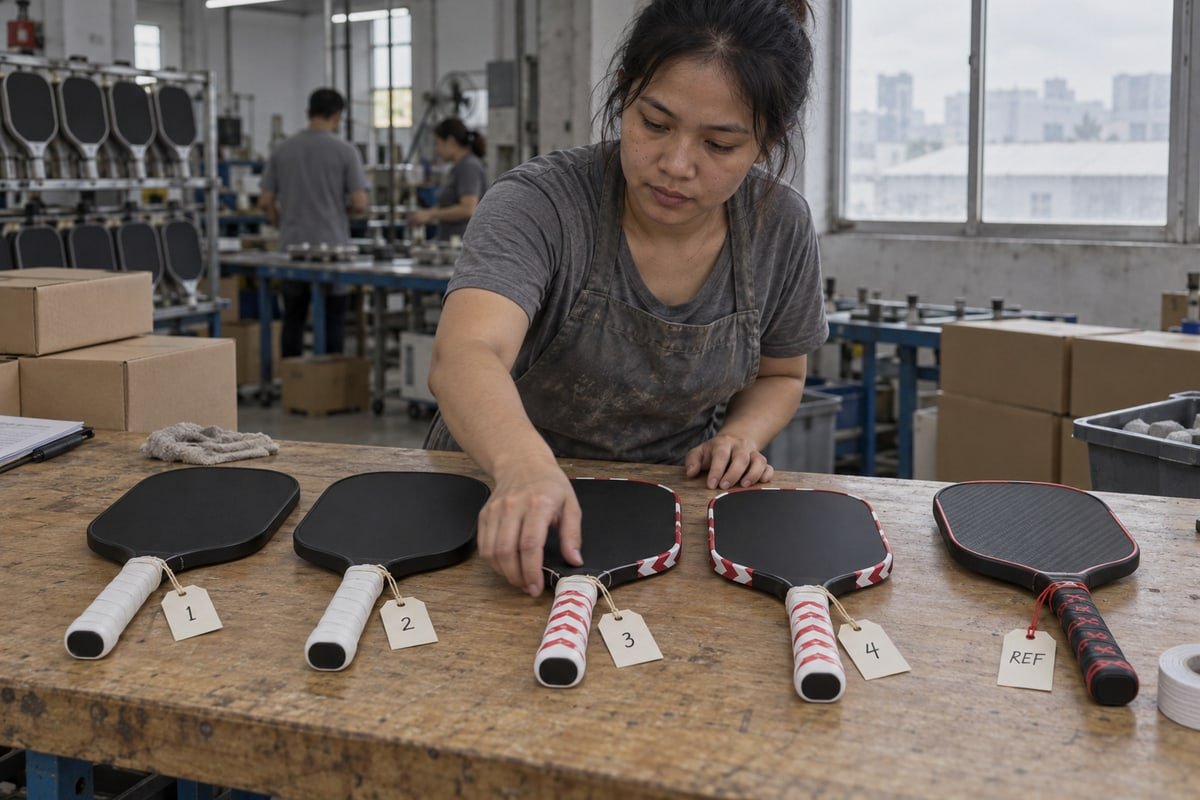
The number matters less than the mix. Each sample type answers a different question, and skipping one leaves a blind spot in your buying decision. In our experience exporting to the United States, Canada, and Southeast Asia, buyers who order the right mix of samples almost never end up in disputes later.
Match the sample type to the risk
| Sample Type | What It Validates | When You Need It |
|---|---|---|
| Blank sample | Core response, face stiffness, build quality | Judging construction and playability |
| Branded prototype | Logo placement, graphics, finish, packaging | Testing your artwork and brand look |
| Full-kit sample | Retail box, head cover, dimensional weight | Planning freight and logistics costs |
| Golden sample (PPS) | Binding quality benchmark from the real line | Right before mass production |
The blank sample is where I tell buyers to be ruthless. Break it. Run destructive stress tests. Look for delamination or core-crush issues before you invest in expensive custom artwork. A branded prototype, by contrast, is for your eyes and your customers' eyes: ink durability, color vibrancy, and edge guard fit.
How minimum order quantity shapes your sampling strategy
Minimum order quantity affects how much sampling risk you can afford. Industry MOQs commonly range from 10 to 100 units depending on the supplier and customization level. If your first order is only 20 paddles, two samples may be enough. If you are committing to 100 or more units, comparing at least two suppliers side by side is worth every dollar. The golden sample then becomes your quality control inspection reference—the paddle any future dispute is measured against.
What should I check when I receive a custom pickleball paddle sample?
Our QC team once stripped the face off a returned paddle and found crushed honeycomb cells hiding under a flawless paint job. Surfaces can lie.
Check the weight, balance, grip circumference, core response, and edge guard fit first. Then verify surface grit against USAPA roughness limits, inspect graphics accuracy, tap the face to find dead spots, and shake the paddle to detect core rattling before you approve production.
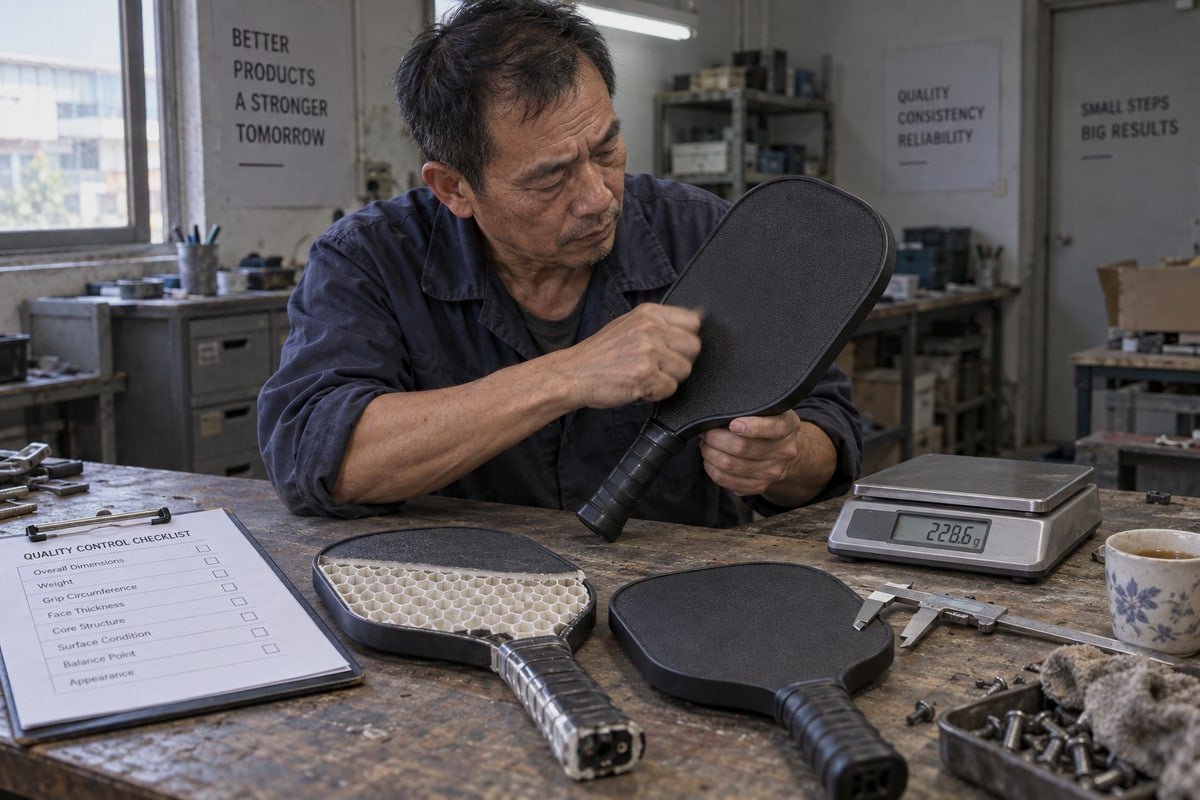
A sample is only useful if you test it systematically. I recommend buyers work through the paddle in three passes: construction, compliance, and branding. Each pass catches a different class of defect.
Pass one: construction and playability
Start with the spec sheet. Weigh the paddle. Measure the length, width, thickness, and handle circumference. Confirm the core is what you ordered—for example, a 16mm Gen5 polypropylene honeycomb core 2 built with a one-piece hot-pressing process, which is our most requested build. Then play with it. Hit balls from the center and from the edges. A healthy sweet spot responds evenly. Dead spots or rattling sounds signal core damage or poor bonding under the carbon fiber surface.
Pass two: compliance and durability
If you plan to sell into tournaments, USAPA approval standards 3 matter from day one. Verify that the grit and surface friction sit within the roughness regulations. If you intend to have your model officially listed as tournament legal, you will need a physical sample specifically for submission to the USA Pickleball Equipment Standards Committee. And do not judge durability by first-hit feel alone. Delamination and core crush show up after repeated impact, not on impact one.
Pass three: branding and finish
Compare the printed graphics against your artwork file. If you are testing printing techniques—UV printing 4 versus silk screening—scratch-test the ink and check color vibrancy under daylight. Inspect the edge guard seam, the grip wrap tension, and the handle's ergonomic comfort in your actual hand.
| Check Area | What to Measure | Red Flag |
|---|---|---|
| Weight and balance | Grams, swing weight, balance point | More than a few grams off spec |
| Core response | Sound and rebound across the face | Dead spots, rattling |
| Surface | Grit level, texture consistency | Fails USAPA roughness limits |
| Graphics | Color accuracy, logo placement | Bleeding ink, misalignment |
| Edge guard | Fit, adhesive strength | Gaps, lifting corners |
How long does it usually take to get a sample from a paddle manufacturer?
Speed sells, but I always weigh it against accuracy. A rushed sample that misses your customization specifications wastes far more time than a careful one ever will.
Standard blank samples usually ship in 2–5 business days. Custom branded samples take roughly 3–10 working days depending on artwork complexity. A full pre-production prototype can take 15–20 business days, plus 7–10 business days in transit, so plan your launch calendar around it.
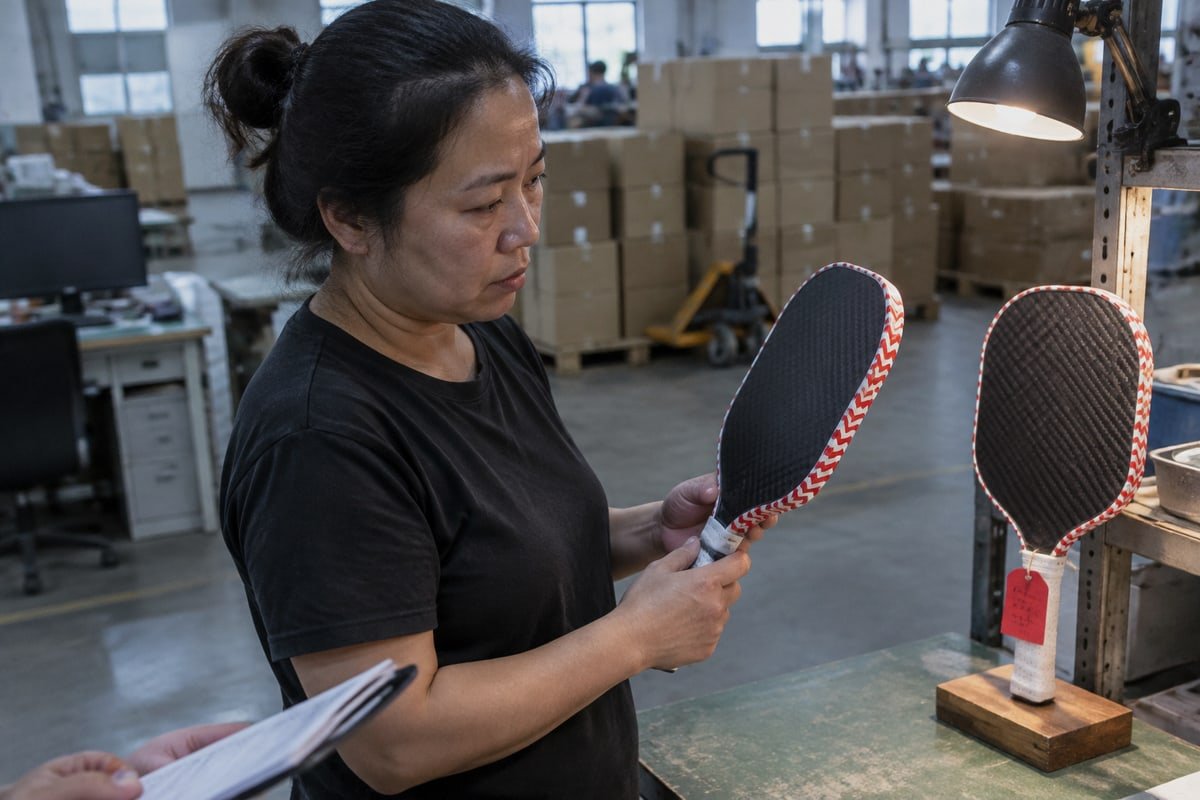
Fast sampling has become a genuine selling point in this industry. Many factories now advertise same-week prototype turnaround because private-label brands want quicker launch cycles. At our facility in Qiaotou, we structure sampling into a clear workflow so buyers always know where their paddle sits in the queue.
A realistic sampling timeline
| Sample Stage | Typical Duration | What Happens |
|---|---|---|
| Blank stock sample | 2–3 days | Pulled from existing builds, shipped fast |
| Standard custom sample | 3–5 days | Your core, face, and weight spec, minimal art |
| Complex branded sample | 3–10 working days | Full graphics, printing tests, packaging |
| Pre-production prototype | 15–20 business days | Built on the actual production tooling |
| International transit | 7–10 business days | Express freight to your door |
Why timelines stretch
Three things slow samples down in my experience. First, new shapes that need mold work. Second, special face materials—sourcing a specific carbon fiber grade, or titanium and Kevlar composites, adds days. Third, artwork revisions. Every round of feedback restarts part of the clock.
Plan backwards from your launch
Here is the approval workflow I recommend. Request photos and videos before the sample ships. Inspect the physical sample when it arrives. Send consolidated feedback in one message, not ten. Approve the revision, then lock the golden sample. Only after that do production lead times for the bulk order begin—typically several weeks—followed by freight and logistics. If your launch date is fixed, count backwards and start sampling at least two months out. Buyers who compress this window are the ones who end up choosing between a delayed launch and an untested paddle.
Should I pay for samples or can I get them for free from my supplier?
Early in our export business, we shipped free samples to almost anyone who asked. We learned quickly that buyers who invest a small sample fee are the serious ones.
Expect to pay for custom samples. Most factories charge a sample fee plus shipping, because a one-off branded paddle interrupts normal production. However, many suppliers—including ours—credit that fee against your bulk order, so confirm sample fee reimbursement terms in writing before ordering.
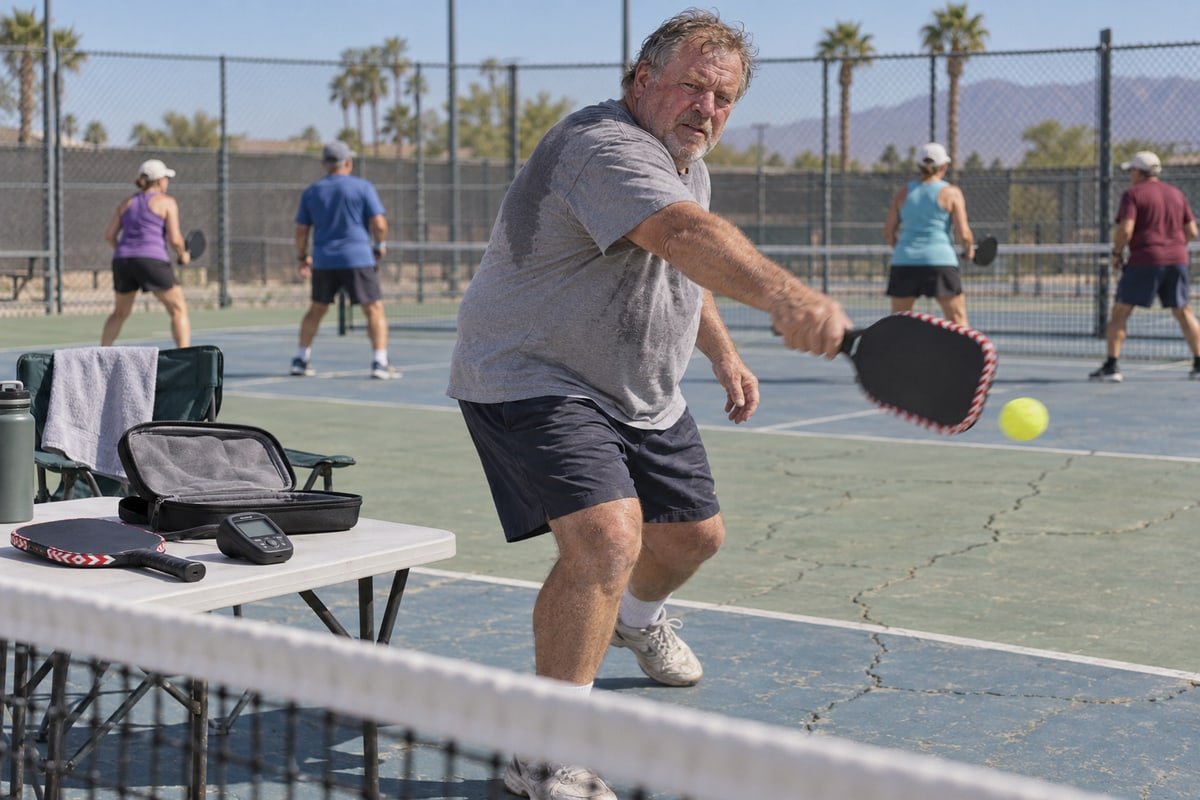
Sample pricing tells you a lot about a supplier, but not in the way most buyers assume. A factory that refuses to charge anything for a fully custom sample is sometimes just relabeling a stock paddle. A fair, transparent sample fee usually means the factory is genuinely building your spec.
What you can expect to pay
Costs break into three parts: the sample fee itself, any pre-production prototype charge, and express shipping. For reference, publicly listed branded paddles start as low as $35 a paddle at the bulk level, and a one-off sample typically costs more than the unit price because there is no economy of scale. Blank stock samples are the exception—many suppliers offer those free or at cost, since they come straight off the line.
When paying is worth it, and when to skip
I will raise the objection some buyers make: if the supplier is trusted and you are only changing artwork, why pay for another sample at all? It is a fair point, and here is how I resolve it. For repeat orders with minor graphic changes, a photo proof or video approval is genuinely enough—we do this weekly with returning clients. But for a first-time supplier, a new paddle construction, or a performance-driven launch, skipping the physical sample is false economy. One bad container of paddles costs a hundred times what the sample did.
Ask your supplier three questions upfront. Is the sample fee deductible from the bulk order? Who pays return shipping on rejected samples? And does the quoted fee cover revisions, or only the first build? Getting those answers in writing protects both sides.
Conclusion
Request custom pickleball paddle samples once your shape, core, and face material are set—always before bulk commitment. Sample smart, test hard, and confirm reimbursement terms upfront.
Interested in sourcing the products mentioned in this article? See details and request a quote here:
- https://shuenpickleball.com/custom-t700-pickleball/
- https://shuenpickleball.com/custom-3k-pickleball/
- https://shuenpickleball.com/custom-12k-pickleball/
- https://shuenpickleball.com/custom-18k-pickleball/
- https://shuenpickleball.com/custom-kevlar-pickleball/
- https://shuenpickleball.com/custom-titanium-wire-pickleball/
Footnotes
1. Economic concept of purchasing large quantities at once to achieve lower unit costs. ↩︎
2. Technical data on the mechanical properties of polypropylene honeycomb structures in sandwich panels. ↩︎
3. Official equipment standards manual for pickleball paddle certification and tournament compliance. ↩︎
4. Technical overview of the ultraviolet curing process used for industrial printing and coatings. ↩︎