Every week, buyers ask our factory about custom pickleball 1 paddles, then go quiet when they hear the MOQ. That silence usually means a good brand idea just stalled.
If you cannot meet MOQ on custom pickleball paddles, you can test with a supplier’s standard stock paddles first, use existing molds and ODM programs, reduce customization, combine designs into one batch, pay a small-order premium, or work with a low-MOQ factory offering runs as small as 5 units.
Each of these options works in a different situation private label sourcing 2. Below, I break down how to find flexible suppliers, what to do when your order is too small, how combining orders works, and when paying extra actually makes sense.
How can I find a manufacturer with a low MOQ for custom pickleball paddles?
A buyer from the Philippines once messaged me on WhatsApp with one line: "MOQ 500 too high. Can you do less?" We started her brand with far fewer paddles, and she reordered twice that year.
Look for factories that advertise small batch manufacturing, private label sourcing, or ODM programs using existing molds. These suppliers often accept 50 units or fewer. At ShuEn Pickleball, we support small-batch custom testing with a minimum order of just 5 paddles.
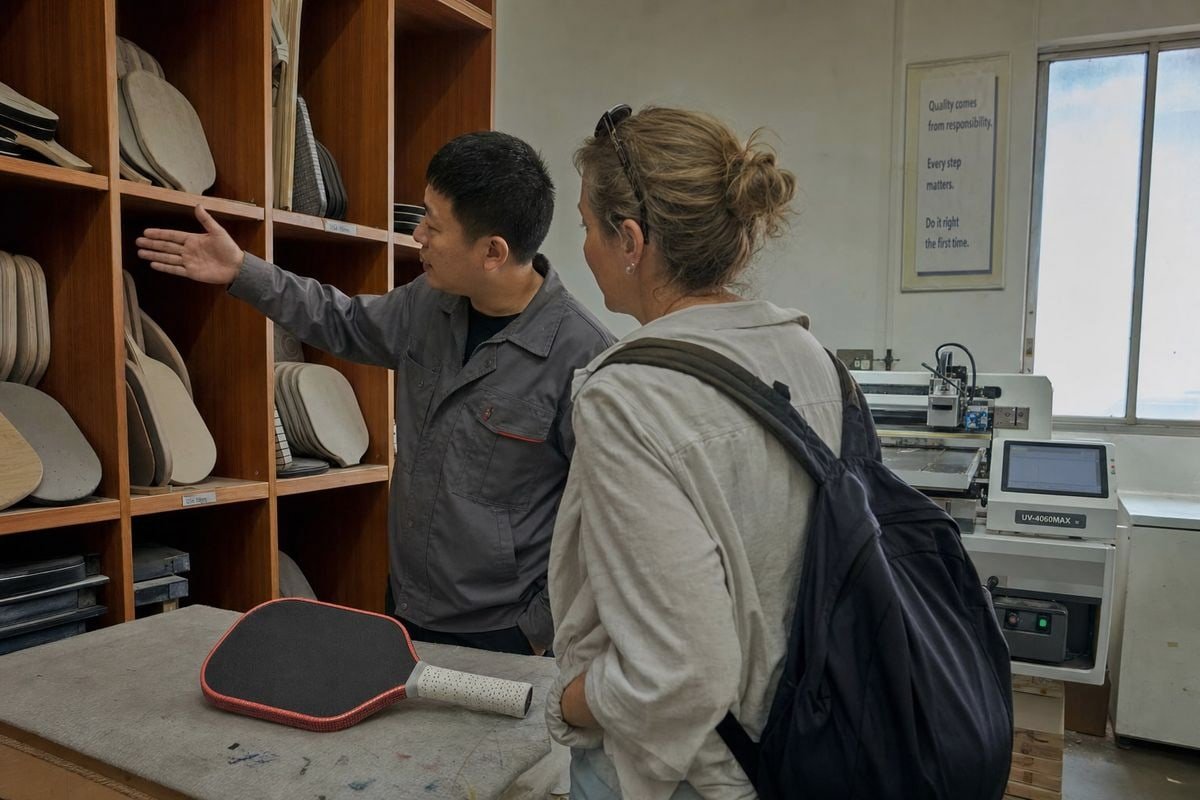
Finding a low-MOQ supplier is mostly about knowing what to search for and what questions to ask. Big-volume factories are built around long production runs. Their machines, painting lines, and packaging stations lose money on tiny orders. Smaller factories and white label suppliers are structured differently. They keep standard paddle shapes, cores, and face materials in stock. That lets them absorb small orders without a costly changeover.
Where to look
Start with suppliers that openly mention "low MOQ," "small order," or "trial order" on their websites or social channels. Then verify three things: the mold library, the printing method, and the certification path. A factory with many existing molds can skip tooling costs. A factory with UV printing 3 services can print one-off graphics without screen-printing setup fees. And a factory familiar with USAPA certification 4 can guide you toward approved constructions from day one, which matters if your paddles will be used in sanctioned play.
Questions that reveal flexibility
| Question to ask | What a flexible answer sounds like |
|---|---|
| Do you have existing molds I can use? | "Yes, here is our catalog of shapes and cores." |
| What printing method do you use for small runs? | "UV digital printing, no plate fees." |
| What is your MOQ for a stock shape with custom graphics? | 5–100 units, not 500+ |
| Can I order samples of your standard paddles first? | "Yes, we recommend it." |
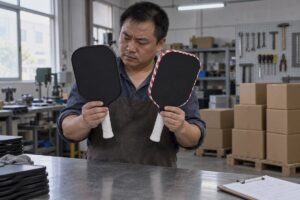
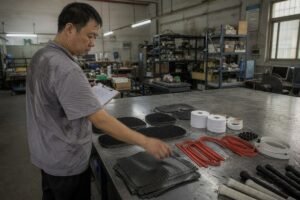
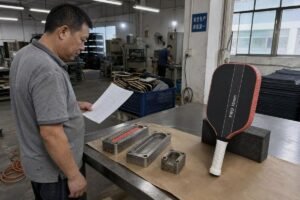
In our own workflow in Dongguan, we keep a catalog of standard paddle shapes, sizes from 406mm to 418mm in length, and 14mm or 16mm thickness options. Buyers pick a base model, and we apply their brand design. Because the mold and core already exist, the economics work even at 5 pieces. Sourcing agents can also help you find factories like this, but going direct usually gives you better pricing and faster answers.
What options do I have if my order quantity is below the standard MOQ?
Here is a lesson from our production line: MOQ is almost never a hard "no." It is a cost-recovery number. When a buyer helps us cover setup costs another way, the number moves.
Your main options are testing standard stock paddles first, reducing customization to graphics only, accepting a higher unit price, meeting a minimum order value instead of a unit count, paying setup fees separately, or negotiating a trial batch with a reorder commitment.
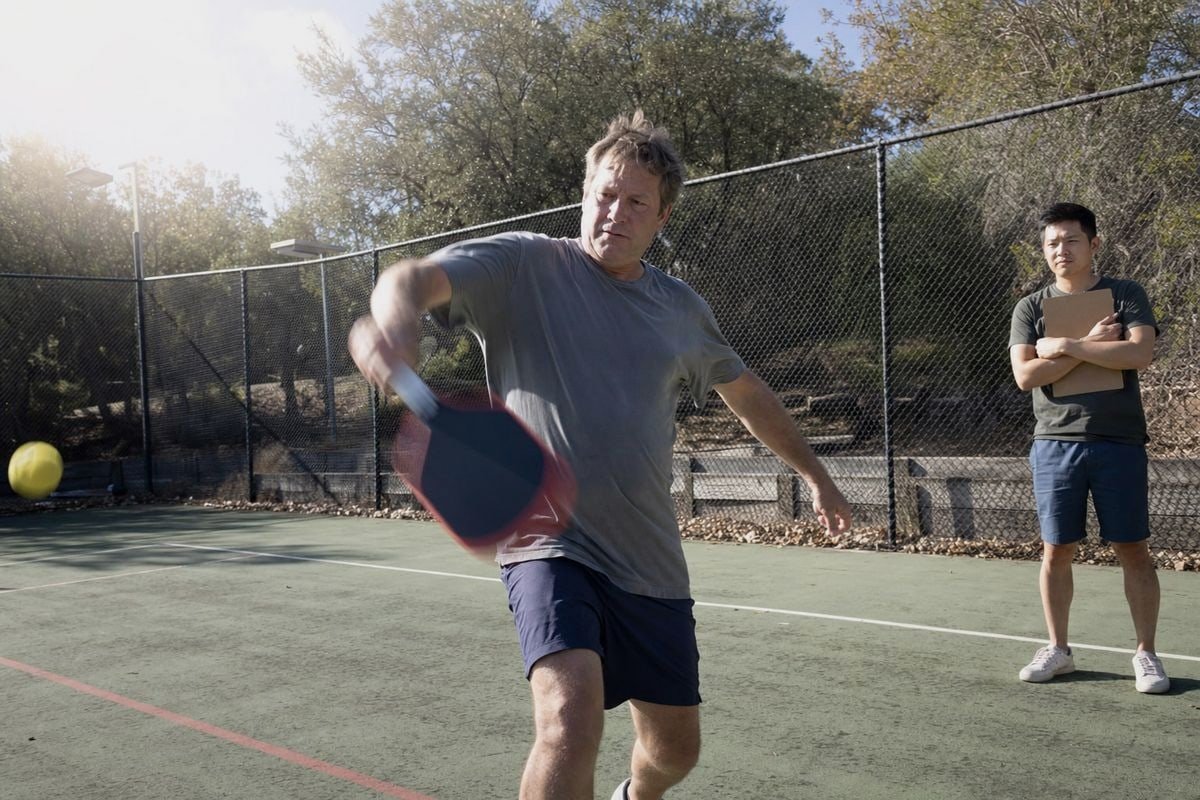
My strongest advice, based on years of helping small brands launch, is this: do not fight for a tiny fully-custom run. Instead, buy the supplier's standard pickleball paddles first and test them. Modern paddles vary widely in core type and face material — Gen5 PP honeycomb cores 5, thermoformed one-piece hot-pressed builds, T700 carbon faces, fiberglass faces, and different thicknesses. Almost every serious supplier already stocks standard paddles covering these combinations. Testing them tells you which construction fits your market before you commit money to branding.
Rank your options from easiest to most strategic
- Order standard samples. Get 2–3 stock paddles in different cores and face materials. Play with them. Let your target players test them.
- Customize graphics only. Keep the stock shape, core, grip, and packaging. Add your logo via UV printing. This is where MOQs drop the most.
- Simplify packaging. Skip custom-printed retail boxes, which often carry 500-unit print minimums. Use generic neoprene covers with high-quality custom stickers instead.
- Pay a small-order premium. A slightly higher per-unit price often beats sitting on 500 unsold paddles. Your inventory management 6 stays healthy.
- Offer a minimum order value. Some factories accept a dollar figure instead of a unit count, letting you mix products.
- Commit to a reorder plan. A written commitment to a second, larger order if sales validate gives the factory confidence to accept a small first run.
Some buyers worry that a higher unit price for a small run is "getting taken advantage of." I understand the fear, but the math usually favors it. Fixed costs spread over 50 units cost more per unit than over 500 economies of scale 7 — that premium is real economics, not a markup trick. Once demand is proven, you scale up and the unit price drops. That is exactly why we set our own minimum at 5 pieces: it lets new brands do prototype development and market validation without inventory risk, using the same materials and technology as top international sports brands.
Can I combine designs or products to meet a supplier's MOQ requirement?
One trade-off we weigh constantly on our line is changeover time versus batch size. That trade-off is exactly why combining designs works — if you combine the right things.
Yes, you can usually combine multiple graphic designs on the same paddle shape and core into one production batch. Factories care most about mold and material consistency, so mixed graphics with UV printing are easy, while mixed shapes or cores are harder.
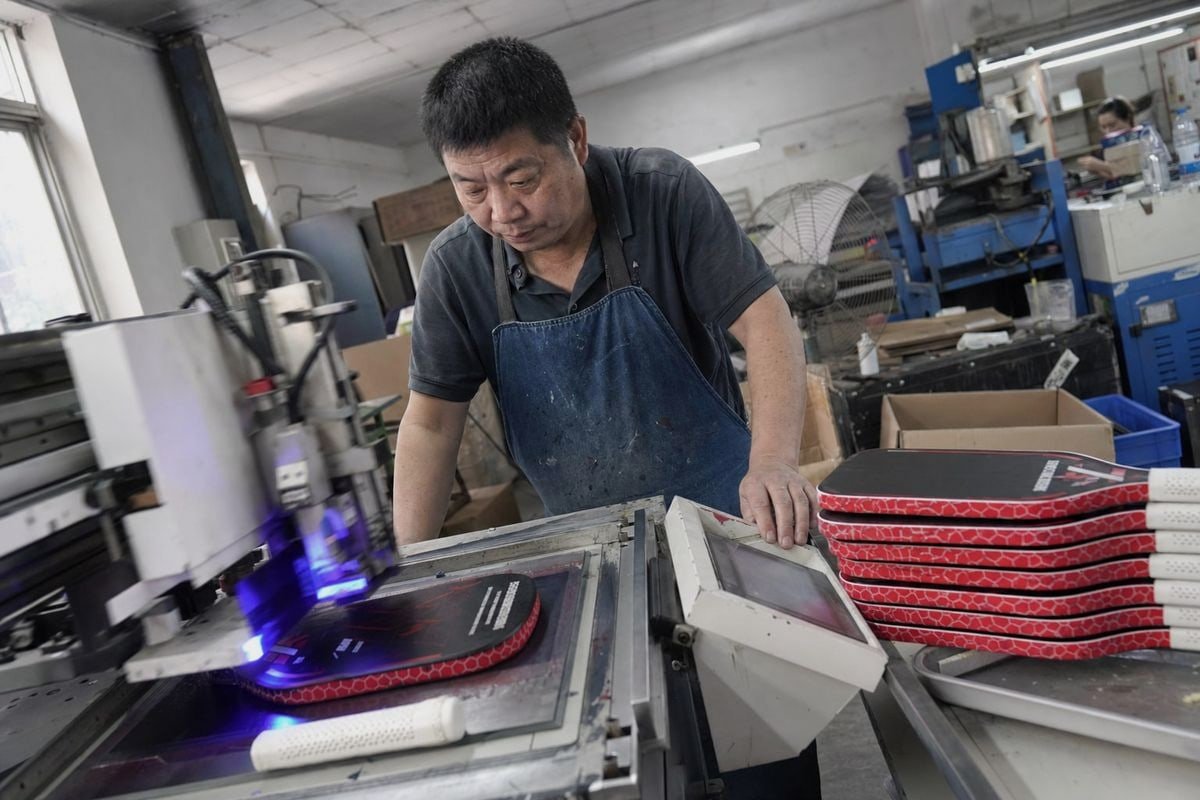
The key insight is understanding what actually drives MOQ inside a factory. It is not the total number of paddles. It is the number of setups. Every time we change a mold, swap a core material, or reconfigure a hot press, we lose production time. But changing a printed graphic on a UV digital printer costs almost nothing. So the smart way to combine is to hold the expensive variables constant and vary the cheap ones.
What combines easily vs. what does not
| Element | Easy to mix in one batch? | Why |
|---|---|---|
| Face graphics / colorways | Yes | UV printing has no plate setup |
| Grip color (stock options) | Yes | Simple assembly swap |
| Edge guard color (stock options) | Usually | Standard component variants |
| Paddle shape / mold | Difficult | Each mold change is a new setup |
| Core type or thickness | Difficult | Different pressing parameters |
| Custom packaging print | Difficult | Print vendors have their own minimums |
Other consolidation tactics
Beyond mixing your own SKUs, you have a few more levers. You can consolidate shipments — produce two small design runs but ship them together to share freight, which meaningfully cuts landed cost. You can explore group buying with other small brands ordering from the same factory, though this needs trust and coordination. And you can ask about material piggybacking: aligning your specs with a factory's current high-volume runs so your small order uses raw material — like T700 carbon fiber 8 rolls — already on the floor.
In our OEM manufacturing work, we regularly run a client's three or four graphic designs across one standard shape in a single batch. From our side, it is one production run. From the client's side, it is a full product line. That is the cleanest way to turn a below-MOQ order into a workable one.
Is it worth paying extra to unlock a smaller custom paddle order?
A distributor in Canada once told me he almost ordered 500 paddles from a big factory to hit MOQ. His first design had a grip circumference his players disliked. Had he paid a little more for 50 units first, he would have saved a warehouse of regret.
Yes, for new brands it is usually worth paying a premium for a smaller order. The extra unit cost is cheap insurance against unsold inventory, design mistakes, and cash-flow strain. Once demand is proven, scale up to a larger MOQ for lower unit pricing.
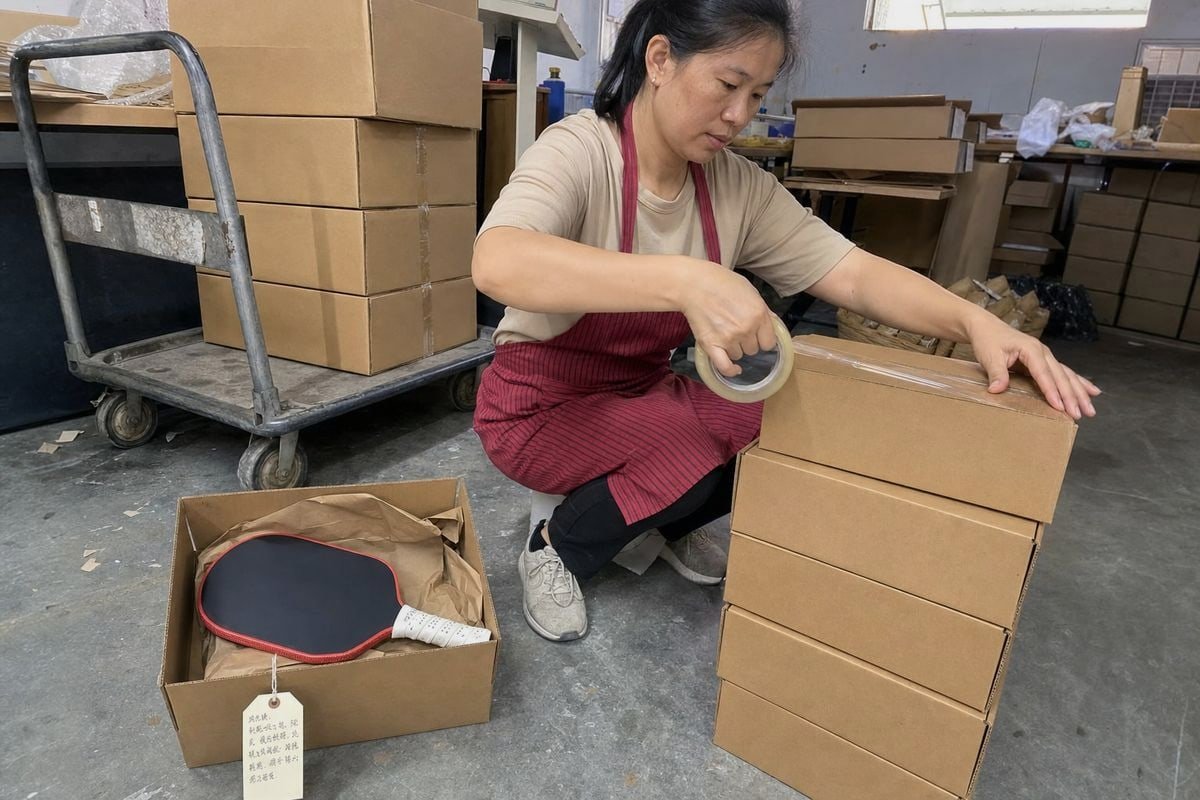
The right way to evaluate this is total landed cost and total risk, not unit price alone. A lower unit price on 500 paddles means nothing if 400 of them sit in storage. Let me frame the decision the way I frame it for buyers who message us.
The real cost comparison
| Factor | Small premium order (e.g., 5–50 units) | Full MOQ order (e.g., 300–500 units) |
|---|---|---|
| Unit price | Higher | Lower |
| Upfront cash needed | Low | High |
| Inventory risk | Minimal | Significant |
| Ability to fix design flaws | Fast, cheap iteration | Locked into one version |
| Storage and inventory management | Simple | Requires planning |
| Best for | Market testing, new brands | Proven demand, scaling |
When the premium stops making sense
There is an honest counterpoint here, and I raise it with our own clients: if your demand is already proven, repeatedly paying small-order premiums is wasteful. A shop owner selling 100 paddles a month should not keep buying batches of 20 at premium prices. At that stage, accept the larger MOQ, lock in the lower unit cost, and negotiate payment terms instead. The small-order premium is a testing tool, not a permanent strategy.
There are also creative middle paths. Some buyers purchase wholesale blank paddles and add branding locally — blank-stock laser marking on raw carbon faces gives permanent, high-fidelity branding without factory printing setups. Others negotiate virtual MOQ agreements: pay for the full raw-material quantity upfront, then have the factory brand and ship in small sub-batches as sales come in. You can also differentiate through modular components — custom grips, branded edge tape, or end caps ordered separately in one low-cost run — layered onto standard paddles.
For most startups, though, the simplest path wins: start with standard samples, run a small premium batch of 5–50 branded paddles, validate sales, then scale. That sequence protects your cash at every step.
Conclusion
Missing MOQ on custom pickleball paddles feels like a dead end, but it rarely is. Test standard paddles, simplify customization, combine designs, or start small with us — from just 5 units.
Footnotes
1. Provides background on the sport driving demand for custom paddles. ↩︎
2. Major B2B sourcing platform relevant to private label and ODM manufacturing programs. ↩︎
3. Explains the digital printing technology used for low-MOQ graphic customization. ↩︎
4. Reliable Wikipedia entry for the governing body that establishes equipment standards and certification. ↩︎
5. Background on the composite core structure used in paddle manufacturing. ↩︎
6. Background concept on managing stock risk discussed in relation to order size. ↩︎
7. Authoritative Wikipedia source defining the economic concept of cost advantages from production volume. ↩︎
8. General