Custom design complexity shapes pickleball paddle pricing more than most buyers realize. On our production line in Dongguan, I see brands overpay simply because nobody explained where the real costs hide.
Custom design complexity affects pickleball paddle pricing through fixed setup costs, not just decoration. Face artwork is often free, but logo molds for edge guards (¥800), grip leather (¥1600), and end caps (¥350) add one-time tooling fees, while full OEM molds can cost $3,000–$8,000.
Let me break this down piece by piece. Once you see the cost structure, you can plan your custom paddle project with confidence and avoid the traps that catch first-time buyers.
How much extra will my custom logo or multi-color design add to the paddle price?
A buyer from the Philippines once asked me why her quote jumped after she added a logo to the grip end cap. The answer surprised her: the face artwork itself was free.
Face graphics, including multi-color designs, are free at ShuEn Pickleball. Extra costs come from component logo molds: ¥800 for a custom edge guard logo, ¥1600 for grip leather, and ¥350 for the end cap. These are one-time fees, never charged again for reorders.
Here is the part that most sourcing guides get wrong. They lump all customization into one bucket. In reality, the paddle face and the paddle components follow completely different cost rules.
Face artwork: usually the cheapest part
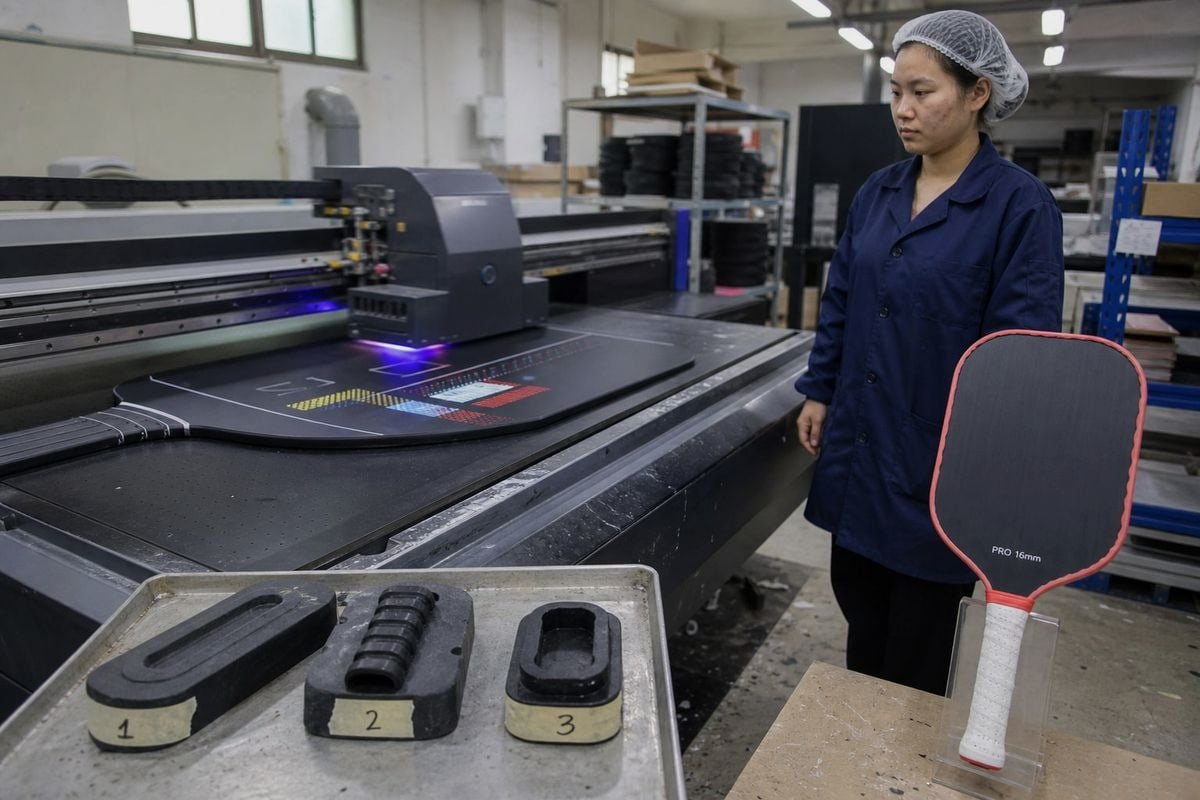
Our design team creates the entire paddle face design for free. Whether you want a single centered logo or a full-face, edge-to-edge multi-color graphic, modern UV printing technology 1 handles both on the same machine pass. Industry-wide, simple logo printing runs about $0.30–$0.80 per paddle plus setup, while full-face sublimation adds roughly $1.00–$2.50 per paddle. Some decorators charge extra for two-sided work — one branded example lists a $70 one-time fee for different front and back designs, and another charges $5 per paddle for double-sided printing. Compared to tooling, these graphic design fees are small.
Component logos: where molds enter the picture
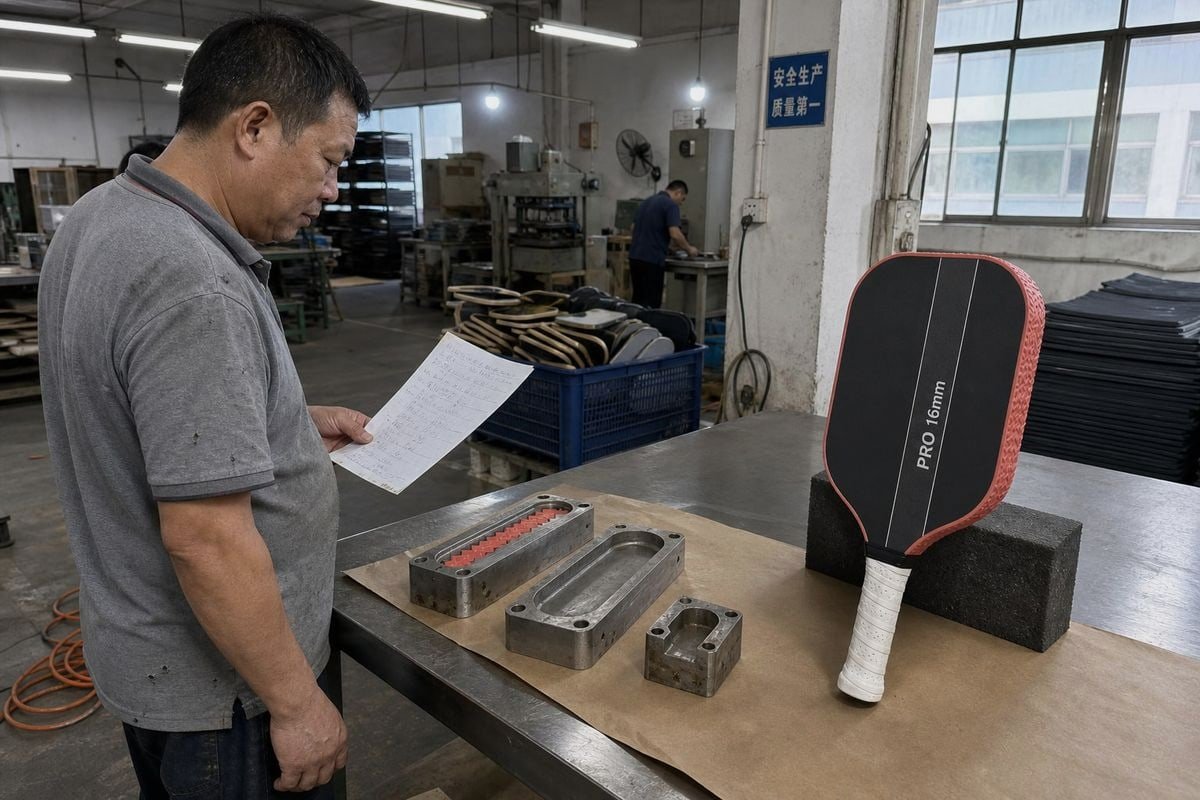
The moment your logo needs to appear on a molded part, tooling is required. Here is our exact fee schedule:
| Component | One-Time Mold Fee | Charged on Reorders? |
|---|---|---|
| Paddle face artwork (any complexity) | Free | No |
| Edge guard (rubber trim) logo | CNY ¥800 (~$110) | No |
| Grip handle leather logo | CNY ¥1600 (~$220) | No |
| Grip end cap logo | CNY ¥350 (~$50) | No |
The key word is one-time. When you reorder with the same logo, we pull your existing mold off the shelf. Your second production run carries zero tooling cost. That is why I always tell brand owners: think of mold fees as an investment in your brand identity, not a per-order expense.
Why does a one-piece hot-pressing process cost more than simpler printing methods?
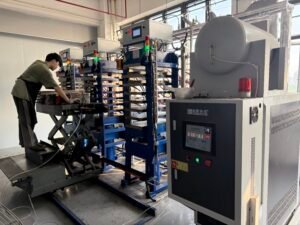
When we developed our Gen5 PP honeycomb core paddles, the biggest engineering investment was not the artwork. It was the one-piece hot-pressing line itself.
One-piece hot-pressing costs more because it fuses the carbon fiber surface, honeycomb core, and edges in a single heated mold cycle. This demands specialized presses, precise temperature control, longer cycle times, and skilled labor — unlike printing, which only decorates an already-finished paddle.
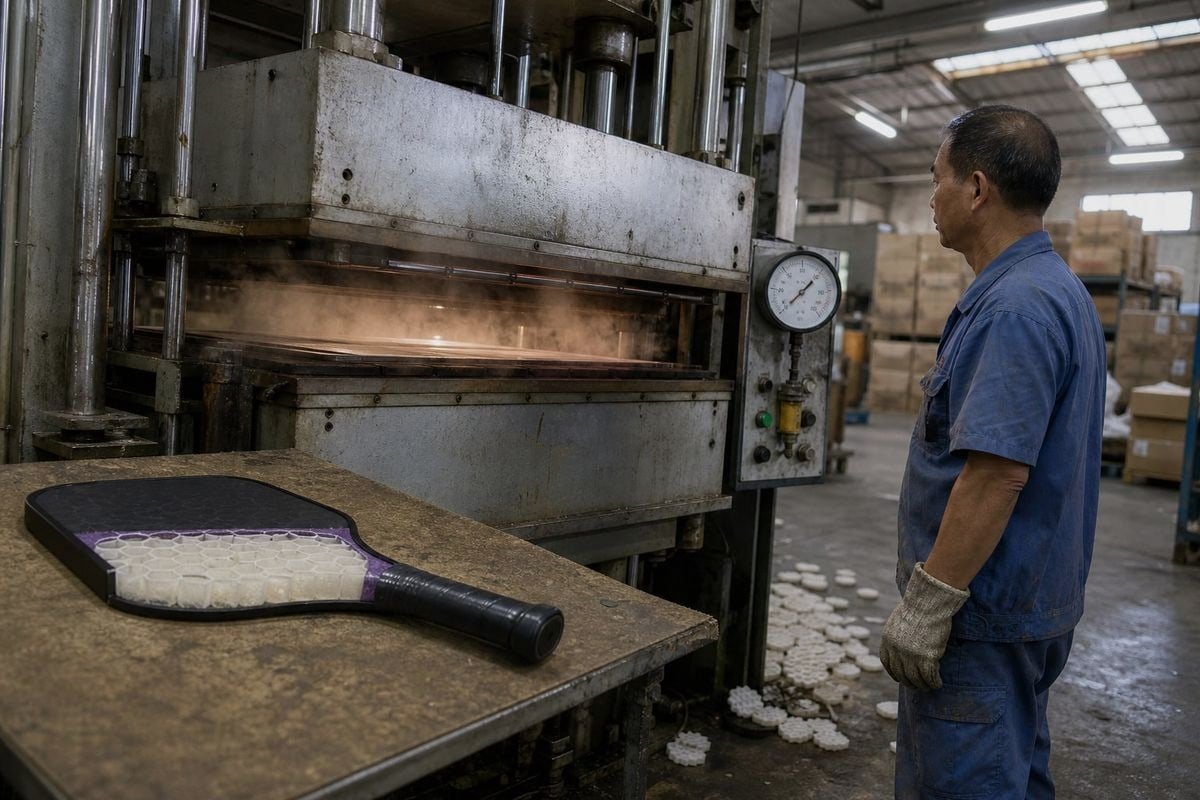
People often confuse two very different things: how a paddle is built and how a paddle is decorated. Printing methods sit on top of a finished paddle. Hot-pressing determines what that paddle actually is.
Construction cost vs decoration cost
A screen print or UV print takes seconds per paddle. A one-piece hot-pressing cycle takes far longer. The press must heat the layup evenly, hold pressure across the honeycomb core material 2, and cool the paddle without warping. Every paddle occupies a press station for the full cycle. That machine time is a real cost, and it scales with volume.
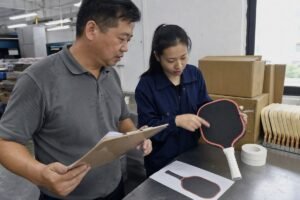
There is also a rejection-rate factor. Aligning intricate face artwork with the friction-enhancing surface texture requires high-precision registration. When the texture and graphic must synchronize, tolerances tighten, and more paddles fail QC. On our line, we weigh every paddle to 230±5g and inspect surface texture friction consistency before printing even begins. Those rejected shells are absorbed into the unit price.
Why the premium is worth paying
| Factor | Simple Glued Construction | One-Piece Hot-Pressing |
|---|---|---|
| Edge durability | Edges can delaminate | Fused unibody edges |
| Sweet spot | Standard | Larger and more stable |
| Vibration dampening | Moderate | Superior |
| Machine time per paddle | Short | Long (full press cycle) |
| Typical FOB position | $6–$11 entry tier | $18–$30 premium tier |
Industry sourcing data backs this up: entry-level paddles run $6–$11 FOB, mid-tier $11–$18, and premium thermoformed paddles $18–$30. The gap is not decoration. It is engineering. And for competitive play, that engineering directly affects durability and control — which is why our thermoformed paddles are built to USAPA approval standards using the same materials as top international sports brands.
Can I keep my custom paddle affordable without sacrificing design quality or brand identity?
The smartest brand owners I work with all follow the same playbook: they put their money where the mold already exists.
Yes. Start with our existing paddle shapes and free face design service, use full-color UV printing for brand graphics, and add component logo molds selectively. Ordering higher quantities spreads one-time fees thinner, keeping strong brand identity at mid-range per-unit pricing.
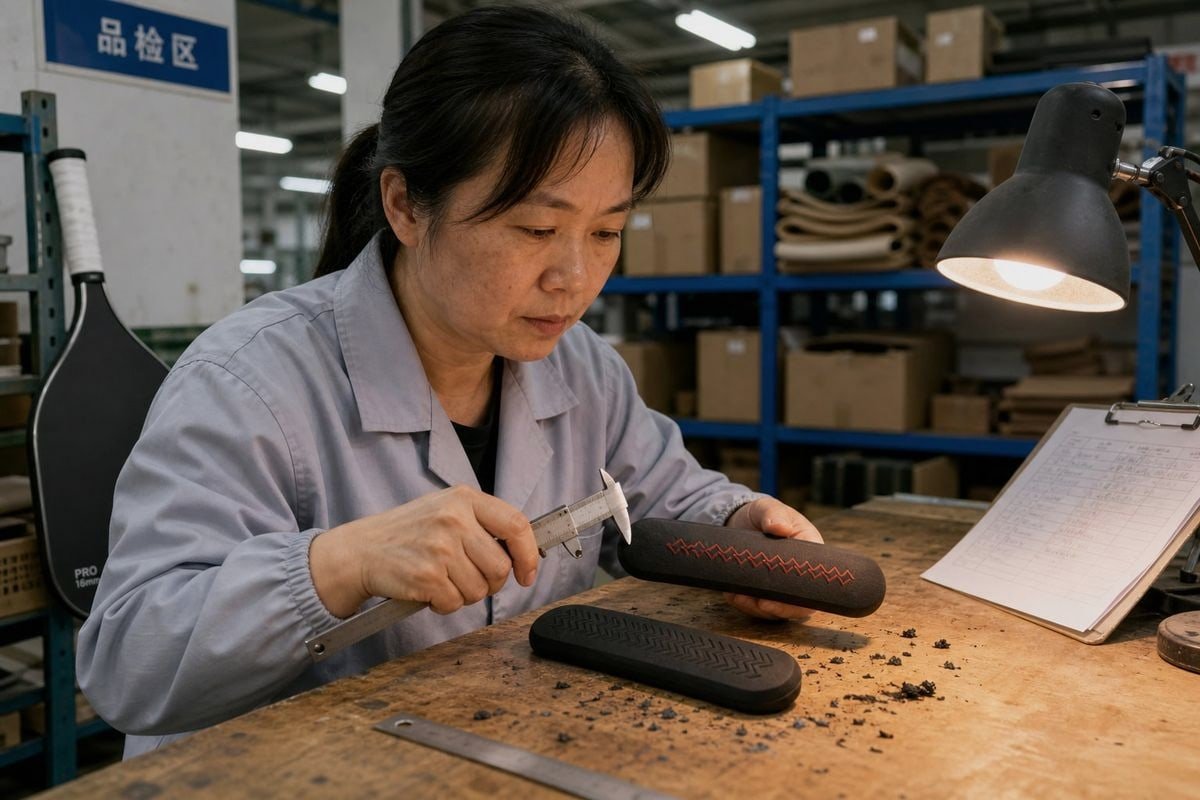
Affordability in custom paddles is not about cutting quality. It is about knowing which costs are fixed, which are variable, and which are avoidable.
Lean on existing platforms first
We keep a catalog of standardized blank paddle shapes — six variants ranging pickleball paddle standards 3 from 406–418mm in length and 188–203mm in width, with 16mm or 14mm cores. Choosing one of these means zero structural tooling cost. A full custom OEM shape, by contrast, can require mold investment of roughly $3,000–$8,000, plus prototype development, sampling, and potentially $6,000–$7,000 per model for USAPA certification. For a small private-label brand, that math rarely makes sense on a first order.
Let volume do the work
Minimum order quantity is the single biggest lever on unit price. Fixed costs — mold fees, setup, proofing — get divided across every paddle in the order. Published sourcing examples show a mid-tier carbon fiber paddle dropping from $22–$30 per unit at 100 pieces to $10–$14 at 1,000 pieces. Another example shows $85 for one custom paddle falling to $55 at 100+ units. The paddle never changed; the volume dilution did.
Prioritize brand touchpoints by cost-to-impact ratio
- Face artwork — free with us, highest visibility. Always do this.
- End cap logo — ¥350 one-time. Cheap, seen every time a player grips the paddle.
- Edge guard logo — ¥800 one-time. Strong shelf presence.
- Grip leather logo — ¥1600 one-time. Premium feel, best for established lines.
Add these in order as your budget allows. Since all mold fees are one-time, your second production run gets every branded component with no tooling cost at all. That is when your wholesale manufacturing costs drop to their true baseline, and your margins open up. One thing I will say plainly: buyers sometimes worry that "custom is mostly a marketing premium" and that they are being taken advantage of. When the customization stays on an existing platform, that worry is fair — which is exactly why we itemize every fee upfront instead of hiding tooling inside inflated unit prices.
What design factors should I simplify if I want faster delivery at a lower cost?
Fast delivery is the number one request I hear on WhatsApp from repeat buyers. The pattern is always the same: the simplest spec sheets ship first.
Simplify by choosing an existing paddle shape, skipping new component logo molds on the first order, using identical front and back graphics, standard grip colors, and stock packaging. Each avoided mold or proofing round cuts days off the lead time for production.
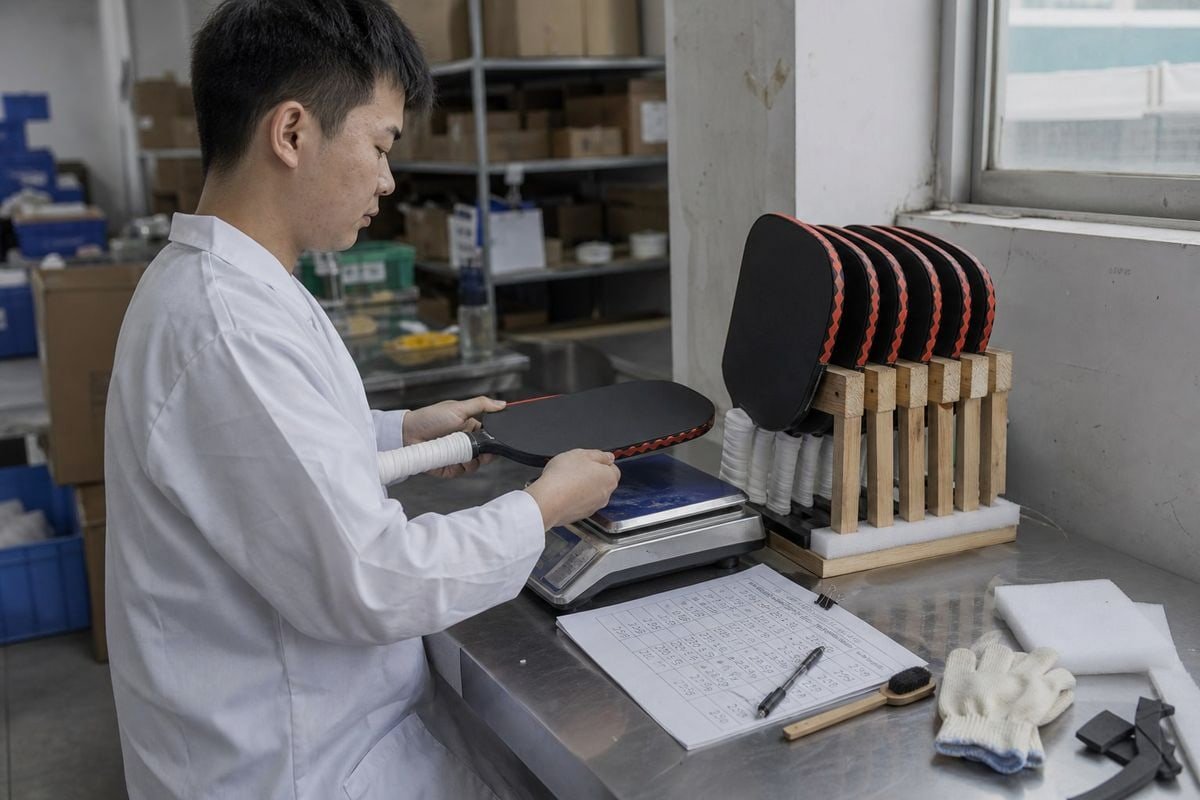
Every custom element adds a step. Every step adds calendar days. If speed matters to you, audit your design spec against this table before you place the order.
| Design Factor | Keep Simple (Fast + Cheap) | Go Complex (Slower + Costlier) |
|---|---|---|
| Paddle shape | Existing catalog mold | New OEM mold: $3,000–$8,000 + weeks of tooling |
| Face graphics | Same design both sides | Different front/back; texture-graphic sync |
| Edge guard | Stock black or color | Custom logo mold: ¥800, adds mold lead time |
| Grip | Stock white/gray wrap | Logo-embossed leather: ¥1600 mold |
| End cap | Blank stock cap | Logo mold: ¥350 |
| Sampling | Digital proof + photo | Physical pre-production sample rounds |
| Extras | None | NFC tags, eco-resin tiers, AR previews |
The three biggest time sinks
First, new molds. Any component logo mold must be machined before mass production starts. On a first order, this adds days you cannot recover. My advice: launch with free face branding, then add component molds on your reorder when the timeline pressure is off.
Second, sampling rounds. Physical pre-production samples can cost $300 each in some programs and add a full shipping-and-approval loop. A high-resolution digital proof approves in hours, not weeks. We handle most first orders this way.
Third, artwork revisions. Send print-ready vector files 4 with confirmed colors. Every revision cycle restarts the proofing clock. Buyers like Marites, who send a final design once and approve fast, consistently get the shortest production windows from us.
Emerging add-ons — NFC authenticity tags, bio-based resin eco-tiers, 3D digital twin previews — are real market trends, but each one is a surcharge and a schedule item. Save them for version two of your product line.
Conclusion
Custom design complexity prices out through fixed costs: free face artwork, one-time component molds (¥350–¥1600), and $3,000–$8,000 OEM tooling. Spend on structure, brand smart, reorder cheap.
Footnotes
1. Explains the technical process of UV curing used for applying durable, multi-color graphics to paddle surfaces. ↩︎
2. Authoritative Wikipedia entry explaining the structure and properties of honeycomb materials. ↩︎
3. Wikipedia section detailing official equipment specifications and paddle dimension requirements. ↩︎
4. Defines the standard digital format for high-quality, scalable artwork required for professional paddle branding. ↩︎