Choosing weight and grip size for custom pickleball paddles trips up more buyers than any spec on our order sheets. Guess wrong, and your whole inventory sits unsold.
Determine weight and grip size for custom pickleball paddles by profiling your target customer first: match paddle weight (7.3–8.5 oz) to skill level and playing style, match grip circumference (4.0–4.5 inches) to hand measurements, then validate both through sample testing before bulk production.
This sounds simple. It is not. Below, I break down each decision step by step, using the same process we walk our OEM clients through.
What Paddle Weight Range Should I Choose for My Target Customers' Skill Level?
Last spring, a distributor from Manila asked us to build his entire first order at 8.4 oz. We paused the project. His customers were mostly beginners, and that weight would have hurt his brand.
Choose 7.3–7.8 oz paddles for beginners and casual players, 7.6–8.0 oz for intermediate all-court players, and 8.0–8.5 oz for advanced power players. Lighter weights protect maneuverability and reduce arm strain; heavier weights add drive and stability for stronger hitters.
Weight is the first spec we lock in on any custom pickleball paddle project. It shapes everything else: the core choice, the carbon fiber face layup 1, even the edge guard design. So you need to think about who will actually swing this paddle, not what looks good on a spec sheet.
Match Static Weight to Skill Level
Here is the reference table we share with private-label clients:
| Customer Segment | Recommended Static Weight | Why It Works |
|---|---|---|
| Beginners / casual players | 7.3–7.8 oz | Easy to swing, forgiving, low fatigue |
| Intermediate all-court players | 7.6–8.0 oz | Balanced power vs control |
| Advanced power players | 8.0–8.5 oz | Extra mass drives the ball deep |
| Seniors / players with arm concerns | 7.3–7.6 oz | Reduces strain, supports tennis elbow prevention |
| Youth players | 7.0–7.5 oz | Small frames need low swing effort |
Do Not Ignore Swing Weight
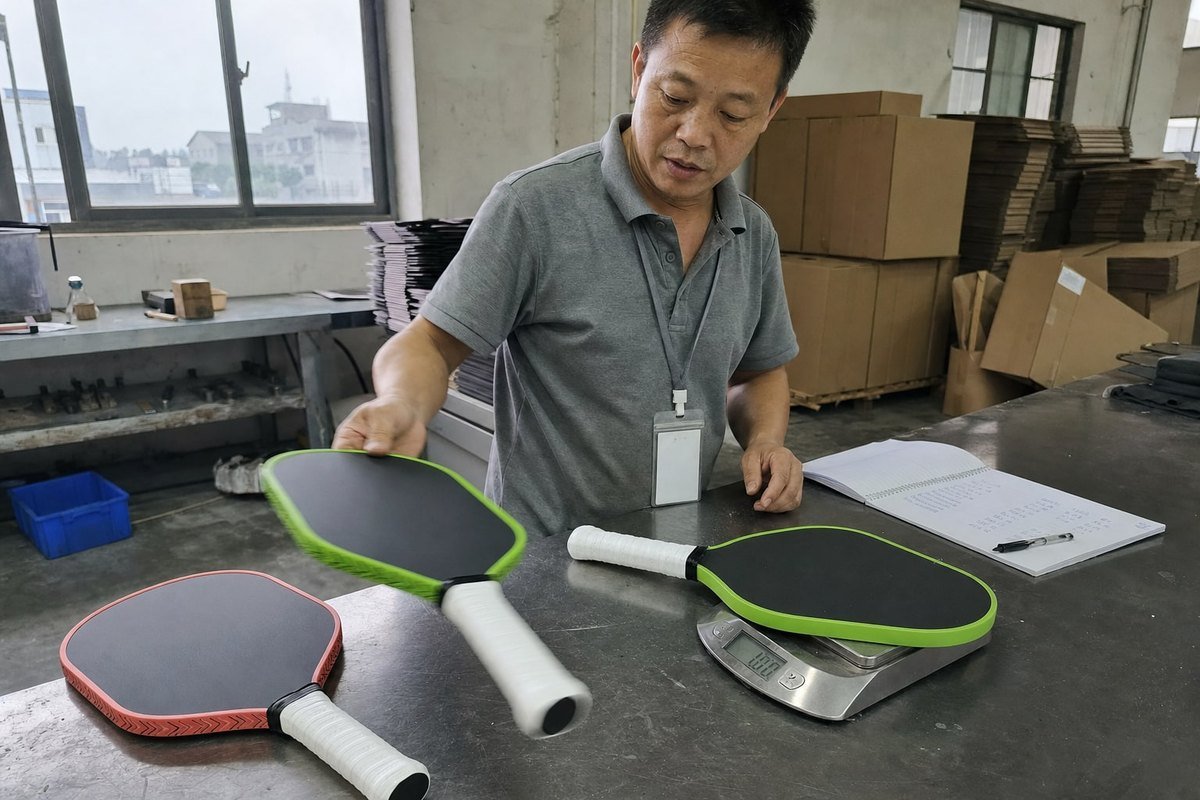
Static weight is what a kitchen scale reads. Swing weight 2 is how heavy the paddle feels in motion. Two paddles can weigh the same but feel completely different if the balance point shifts. A head-heavy 7.8 oz paddle can feel slower at the net than a handle-weighted 8.1 oz paddle. When we build samples in our Dongguan facility, we measure both and report both. Ask your supplier for the same data. If they only quote static weight, they are giving you half the picture.
Consider the Core Material
The core changes how weight behaves. Our polymer honeycomb core 3 options run softer and quieter, which suits control players. A firmer core at the same weight feels punchier. Weight and core must be decided together, never separately.
How Do I Match Grip Size to My Customers' Hand Measurements?
A brand owner once sent us her artwork before her grip spec. We asked her to survey twenty of her club members first. The results changed her entire handle order.
Match grip size by measuring from the middle palm crease to the tip of the ring finger; that length equals the ideal grip circumference. Most adults fall between 4.0 and 4.5 inches. When a customer sits between sizes, choose the smaller one and adjust with overgrips.
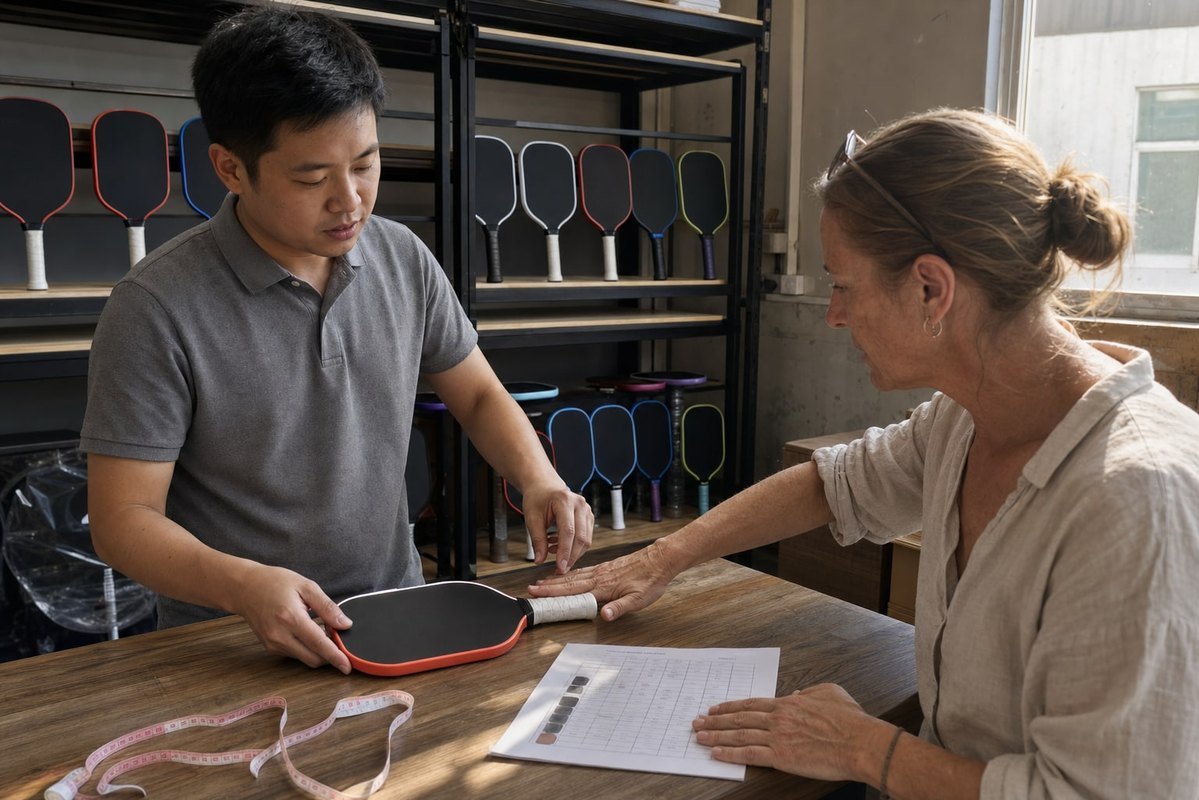
Grip size is described as handle circumference 4, not just "thin" or "thick." Getting it right matters more than most buyers realize. A grip that is too small forces players to over-squeeze, which is a known trigger for tennis elbow. A grip that is too large restricts wrist motion and kills soft-shot touch. Neither problem shows up in photos. Both show up in returns.
The Two Reliable Sizing Methods
First, the palm measurement. Have the player open their hand and measure from the middle crease of the palm to the tip of the ring finger. That number, in inches, is their grip circumference.
Second, the index finger test. Have the player hold the paddle normally, then slide their opposite index finger into the gap between fingertips and palm. A snug fit means the size is correct. Extra space means the grip is too big. No space means it is too small.
Height Charts Are a Backup, Not a Rule
Many buyers rely on height charts. They work as a rough starting point:
| Player Height | Suggested Grip Circumference |
|---|---|
| Below 5'3" | 4.0 inches |
| 5'3" to 5'8" | 4.25 inches |
| 5'9" and above | 4.5 inches |
But hand measurement always overrides height. We have measured tall players with small hands and short players with large hands. If your target market is the Philippines or Southeast Asia, average hand sizes often skew smaller than US charts assume. Order accordingly.
Why We Recommend Sizing Down
Overgrip thickness adds roughly 1/16 inch of circumference per wrap. So a 4.0-inch handle can become 4.125 or 4.25 inches easily. A handle that is too big cannot shrink. This is why we tell private-label clients: when your audience is mixed, build on the smaller base and let end users tune upward.
Why Does Weight Distribution Matter for Different Playing Styles?
Our engineers spend more time on balance point than on total weight. We learned this after a US client reported his elongated samples felt "sluggish" — the fix was moving mass, not removing it.
Weight distribution determines how a paddle behaves in play. Head-heavy balance adds power and plow-through for baseline drivers. Handle-heavy or balanced setups increase hand speed and maneuverability for net players. The same static weight produces opposite results depending on where the mass sits.
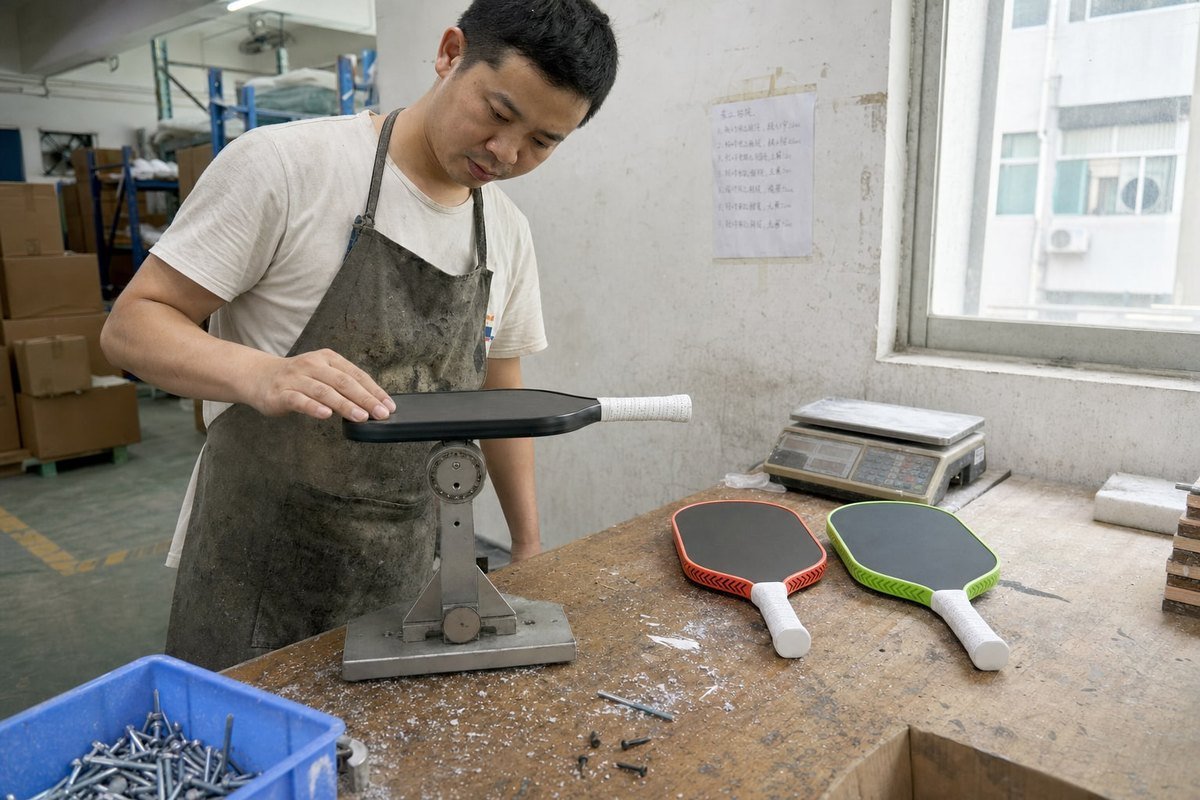
Think of weight distribution as the personality of the paddle. Total weight tells you how much mass exists. Distribution tells you what that mass does during a stroke. For custom builds, this is where you separate your brand from generic catalog paddles.
Three Balance Profiles and Who They Serve
| Balance Profile | Playing Style Match | Effect on Court |
|---|---|---|
| Head-heavy | Power players, baseline drivers | More pop, deeper drives, larger effective sweet spot |
| Even balance | All-court and intermediate players | Predictable feel, balanced power vs control |
| Handle-heavy | Net players, fast-hands doubles specialists | Quicker resets, faster volleys, better maneuverability |
How We Tune Distribution in Production
Adding mass near the paddle head raises swing weight and stabilizes off-center hits. Adding mass at the throat or inside the handle — a technique called counter-weighting — shifts the balance point lower. This lets players use elongated shapes for reach without losing hand speed. Some of our clients also request wider butt caps, a handle flare, which lets aggressive players hold the paddle loosely and reduce forearm fatigue.
Core selection plays into this too. A 16mm polymer honeycomb core 5 distributes mass evenly and adds vibration dampening 6, which softer-handed control players love. Denser core-and-face combinations concentrate feel differently. When we prototype, we often build the same shell with two balance points so the client can feel the difference side by side. Spin-focused players usually land on the balanced or handle-weighted option, because face control depends on quick wrist action. Power players almost always pick the head-weighted sample. Distribution is not a detail. It is the decision.
How Can I Test Multiple Weight and Grip Options Before Placing a Bulk Order?
One of my favorite client stories involves a Filipino business owner who ordered four sample variants, handed them to her local club, and came back with a spec sheet better than most consultants could write.
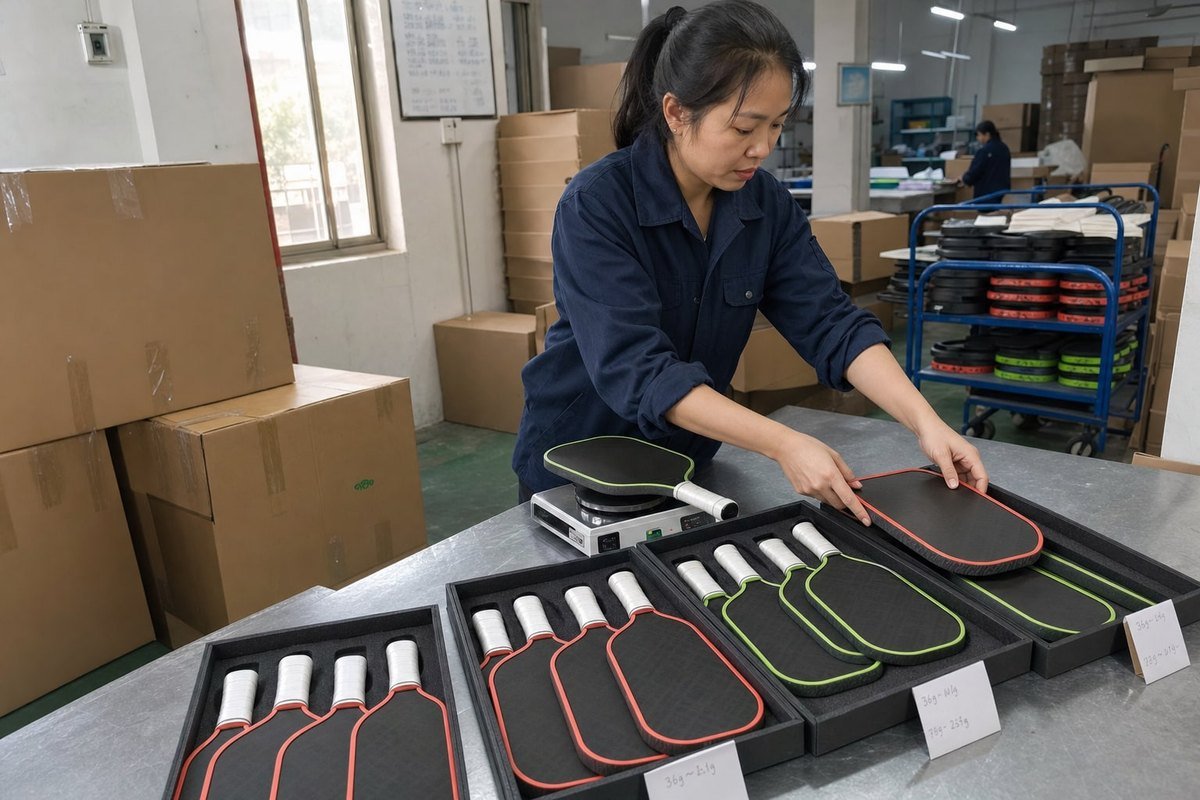
Order samples in your top two or three weight and grip combinations, distribute them to local clubs and competitive players for two to four weeks, collect structured feedback on comfort, power, and control, then finalize your bulk specification based on real play data rather than assumptions.
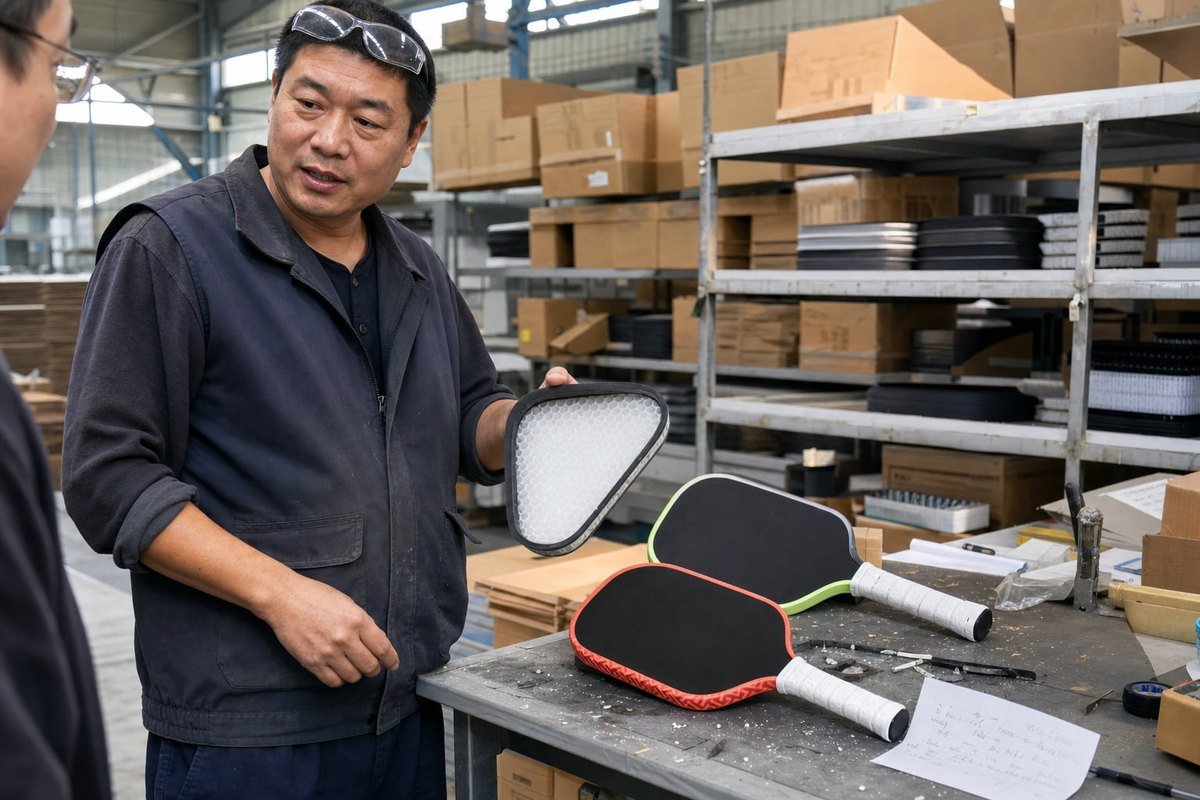
Sampling is where good private-label brands are made. Skipping it is the single most expensive mistake I see new buyers make. Here is the process we recommend to every client, based on how our most successful partners work.
The Four-Step Sample Testing Process
- Source sample paddles first. Start with two or three variants that bracket your target spec — for example, a 7.6 oz and an 8.0 oz build, each in two grip sizes. At our factory, we build samples using the same one-piece hot-pressing process as bulk production, so what you test is what you get.
- Test the core options against real play. We mainly offer four core constructions: PP honeycomb, EPP+EVA, blow-molded carbon fiber 7 frame, and MPP+EVA with carbon fiber. Each changes feel, pop, and vibration dampening. Do not choose from a datasheet. Hit with them.
- Put samples in the hands of clubs and athletes. Give paddles to local pickleball clubs and competitive players for a few weeks. They will expose weaknesses faster than any lab test. Ask specific questions: Does it feel slow at the net? Does the grip cause squeezing? Does the sweet spot feel honest?
- Convert feedback into a final spec. Club and athlete feedback tells you exactly which core, weight, balance, and handle circumference to lock in. That becomes your bulk order specification.
What to Verify Before Committing
Check that your final spec complies with USAPA equipment standards if your customers play sanctioned events. Confirm the factory reports both static weight and swing weight with tolerances. Ask how much unit-to-unit weight variance to expect — a tight tolerance signals real process control. And weigh samples yourself on a digital scale when they arrive. Trust, then verify.
Conclusion
The wrong weight or grip spec can bury a new paddle brand before it launches. Profile your customers, measure real hands, respect swing weight, and always test samples with clubs before you commit to bulk. Fit the player, not the product page — that is how winning custom paddle specs are built.
Footnotes
1. Explains the material properties and construction of carbon fiber layers used in paddle faces. ↩︎
2. Defines the physical concept of how weight distribution affects the feel of a racquet in motion. ↩︎
3. Technical details on non-metallic honeycomb structures used for lightweight, high-strength cores. ↩︎
4. Professional guidance on measuring grip circumference for racquet sports to prevent injury. ↩︎
5. Explains the structural material referenced for paddle core construction. ↩︎
6. Explains the physics of reducing oscillations, crucial for player comfort and reducing arm strain. ↩︎
7. Provides background on the composite material used in paddle faces. ↩︎