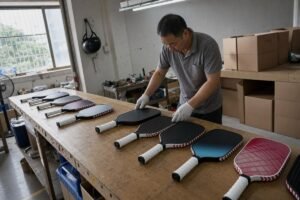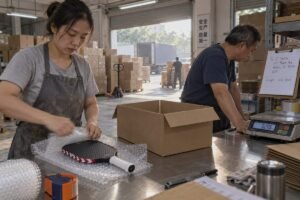
Comparing custom pickleball paddle quotes confuses many buyers. On our production line in Dongguan, I see quotes for the “same” paddle differ by 40% or more. Why? Because they are not the same paddle. If you pick the cheapest number blindly, you risk thin carbon, sloppy tolerances, and [hidden fees](https://shuenpickleball.com/what-hidden-costs-consider-sourcing-custom-pickleball-paddles-china/) that surface after you pay the deposit.
To compare custom pickleball paddle quotes fairly, normalize every quote to the same quantity, then break out unit price, design fees, mold or tooling charges, face material, and core material. Add packaging, shipping terms, and QC costs to calculate a true landed cost per paddle before deciding.
That sounds simple, but each of those five factors hides traps. Let me walk you through how I would compare quotes if I were sitting on your side of the table.
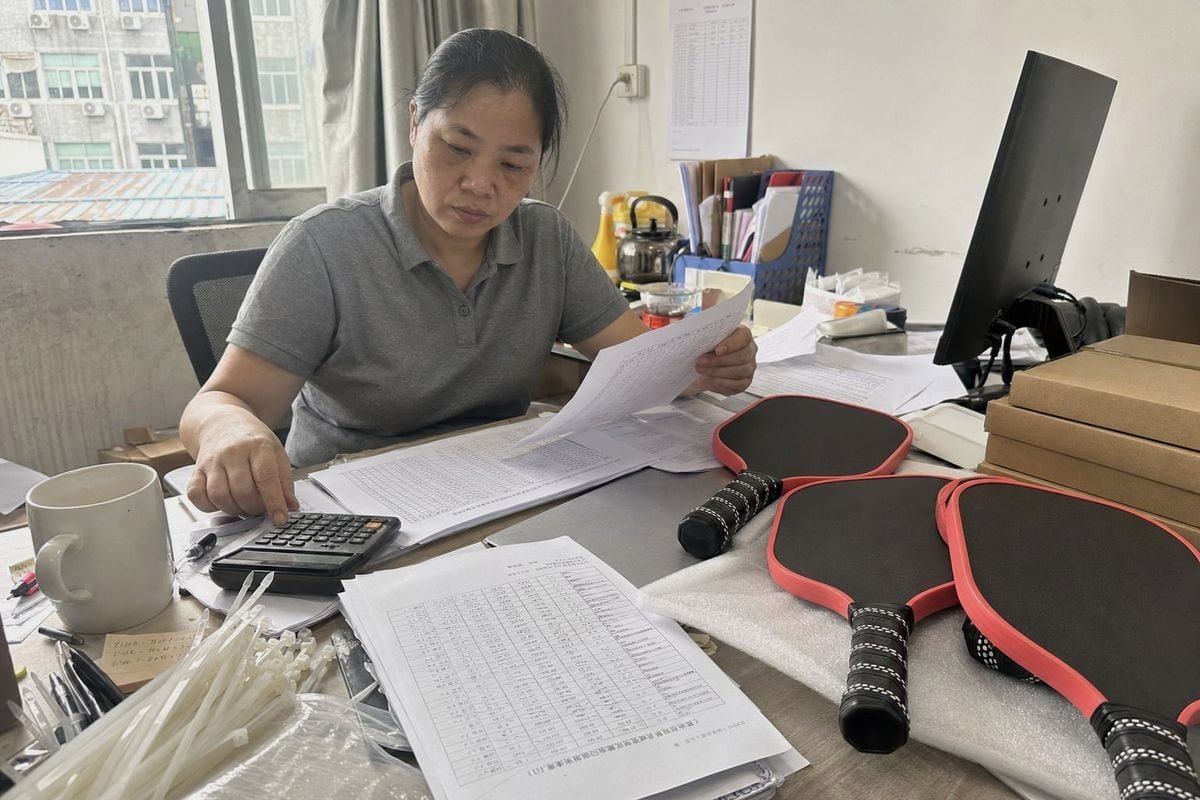
Last month, a buyer sent me a competitor's quote and asked why ours was $2.40 higher. When we lined the two quotes up item by item, ours was actually cheaper overall.
Hidden cost factors include the quantity tied to the quoted price, separate design or artwork fees, one-time custom mold charges, the exact face material grade, and the core specification. Quotes also often exclude packaging, sample production cost, freight, and customs duties, which inflate the real total.
The first thing I always check is quantity. This is the number one rule I give every buyer: only compare the per-unit cost at the same quantity. A wholesale unit price 1 of $13 at 1,000 units and $19 at 200 units can come from the exact same factory using the exact same materials. Market sourcing data backs this up: lower-volume orders of 100–300 units often land around $18–$25 FOB, while 500–1,000 units drop to roughly $12–$18 FOB. If Supplier A quotes at 300 units and Supplier B quotes at 1,000 units, the comparison is meaningless until you align them.
The five cost pillars I check first
- Quantity and unit price. Ask for a tiered price list at 100, 300, 500, and 1,000 units so every supplier is judged on identical volume.
- Design charges. Some factories include artwork proofing and color matching for free; others bill it as a separate line. Ask directly whether design work is charged.
- Custom mold fees. If your paddle shape, edge guard, or handle geometry needs new tooling, expect a one-time charge. Using an existing mold avoids it entirely.
- Face material. Fiberglass, carbon fiber surface, raw carbon, and Kevlar sit at very different price points.
- Core material. A Gen5 polypropylene honeycomb core 2 costs more than a basic polymer core, and Nomex sits in its own bracket.
Typical FOB price bands by build tier
| Build tier | Face material | Typical FOB range | Common core |
|---|---|---|---|
| Entry level | Fiberglass | $6–$11 | Standard PP honeycomb |
| Mid tier | Carbon fiber surface | $11–$18 | PP honeycomb, 13–16mm |
| Premium | Raw carbon / thermoformed | $18–$30 | Gen5 PP honeycomb core |
Then add the customization layer. Basic logo printing usually runs about $0.30–$0.80 per paddle plus setup. Full-face sublimation runs roughly $1.00–$2.50 per paddle plus setup. If one quote includes full sublimation and another includes only a logo, the gap you see is decoration, not greed.
What questions should I ask suppliers to avoid being overcharged on my paddle order?
A distributor from the Philippines once messaged me on WhatsApp with just one line: "Best price, 16mm, my design." I sent back nine questions before quoting, because vague requests invite vague quotes.
Ask suppliers to confirm the MOQ tied to the quoted price, price breaks at higher volumes, whether artwork and mold fees are included, the exact face and core materials, the Incoterm quoted, sample production cost, lead time, QC checks, and weight tolerance ranges.
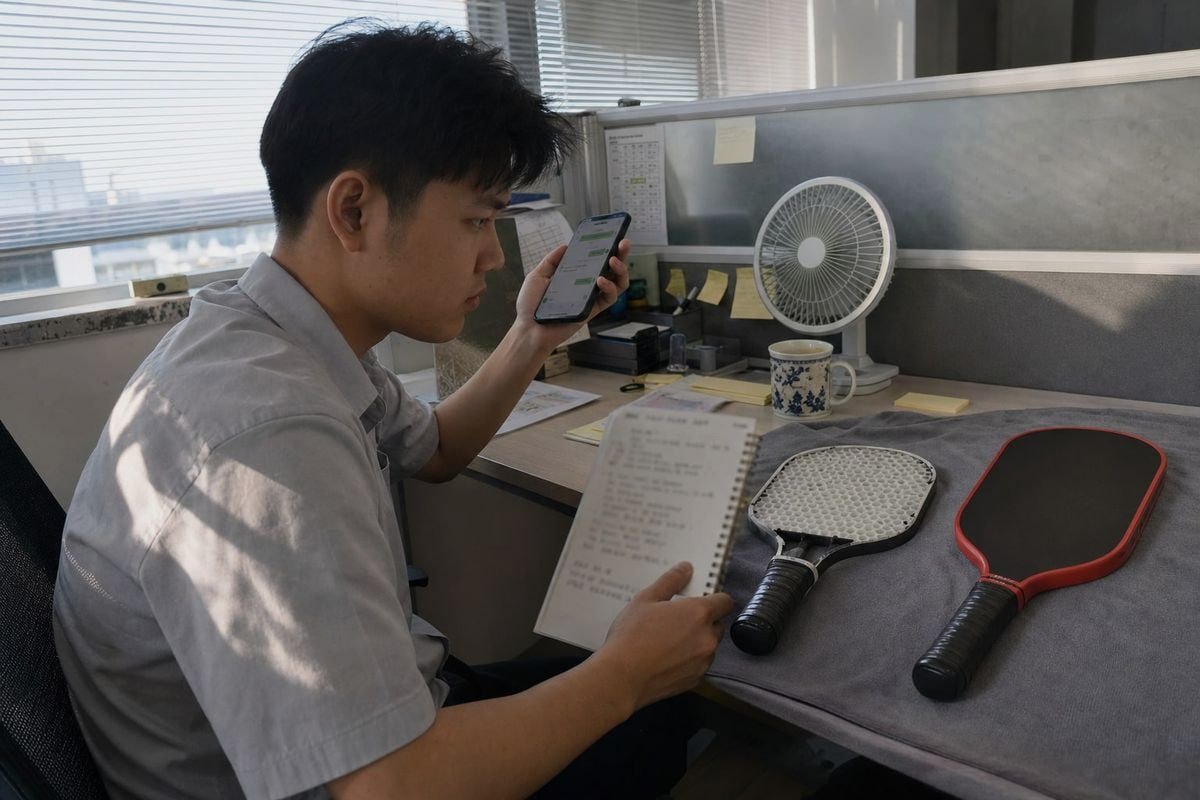
In our experience exporting to the United States, Canada, Italy, and Southeast Asia, buyers who ask precise questions get precise quotes. Buyers who ask "how much for a custom paddle" get whatever number the salesperson thinks will hook them. Here is the checklist I recommend, in the order that matters.
The essential question checklist
| Question | Why it protects you |
|---|---|
| What is the Minimum Order Quantity for this price? | A low price at 1,000 units is useless if you need 200. |
| What are the price breaks at 300, 500, and 1,000 units? | This exposes how the supplier scales cost, and whether your volume gets a fair rate. |
| Is design and artwork proofing included, or billed separately? | Design fees can add hundreds of dollars if unstated. |
| Does my shape require a custom mold, and what is the tooling fee? | One-time mold charges are significant; an existing mold avoids them. |
| What is the exact face layup and core spec? | "Premium carbon" means nothing; "T700 carbon fiber surface over 16mm Gen5 PP honeycomb core" means everything. |
| Which Incoterm is quoted: EXW, FOB, CIF, or DDP? | Each term shifts freight, insurance, and customs duties onto different parties. |
| What is the sample production cost and sample lead time? | Samples reveal the factory's real quality before you commit. |
| What is the production lead time after deposit? | Late delivery kills product launches. Get it in writing. |
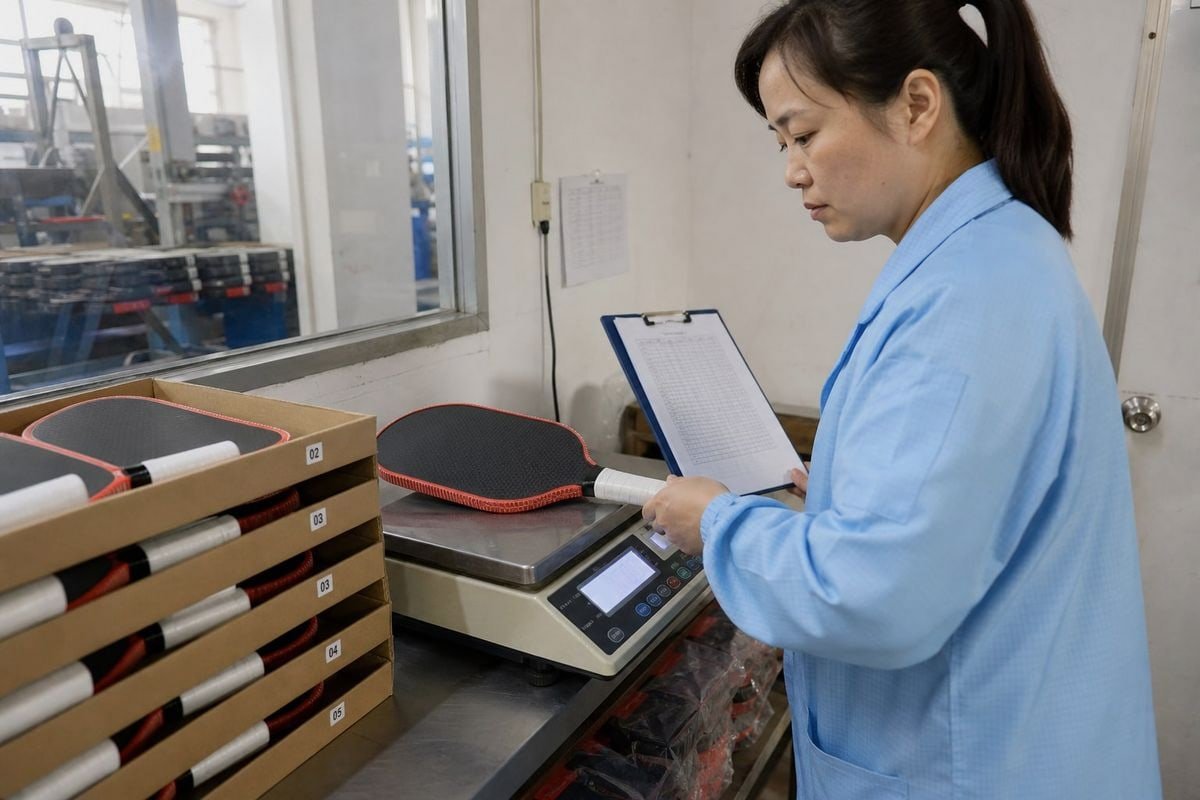
| What QC inspection steps are included, and what is the weight tolerance? | We hold 230±5g on our catalog paddles; a supplier who cannot state a tolerance is not controlling one. |
Two more questions separate serious factories from trading companies. First, ask whether they support pre-checks for USAPA approved standards 3, since USA Pickleball compliance planning should start before production, not after. Second, ask about their tariff situation. Some buyers now request a tariff mitigation strategy, such as final assembly outside China, to reduce Section 301 duty exposure on goods under HS code 9506.99. A supplier who answers these questions clearly is quoting honestly. A supplier who dodges them is hiding cost somewhere.
How do I compare quality and materials across different pickleball paddle manufacturers?
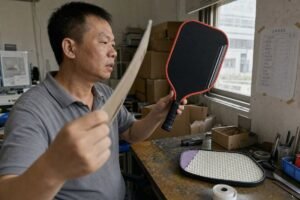
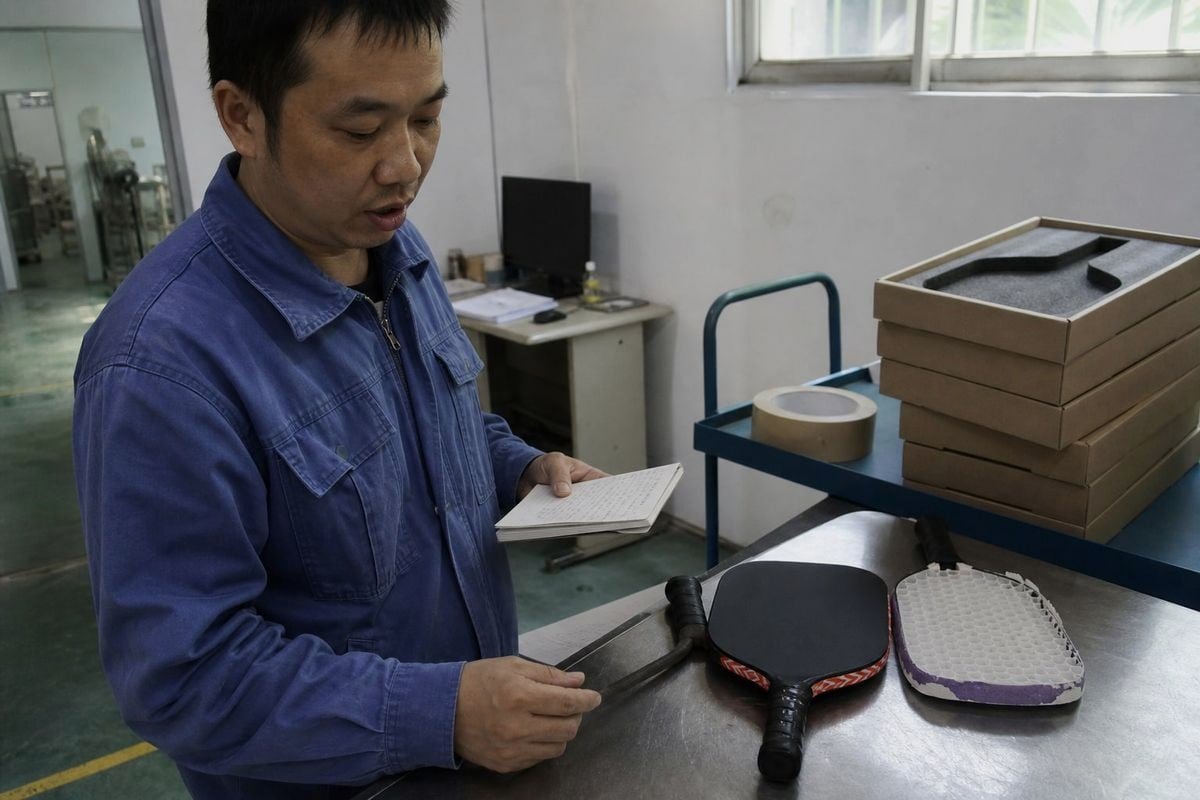
When we cut open a returned paddle in our workshop, the honeycomb core tells the whole story. Crushed cells, excess adhesive, or uneven resin all show up immediately.
Compare manufacturers on face material grade, core type and thickness, construction method, and tolerance control. A carbon fiber surface over a Gen5 polypropylene honeycomb core, built with one-piece hot-pressing, outperforms a cold-pressed fiberglass paddle, and the price gap reflects real material and labor differences.
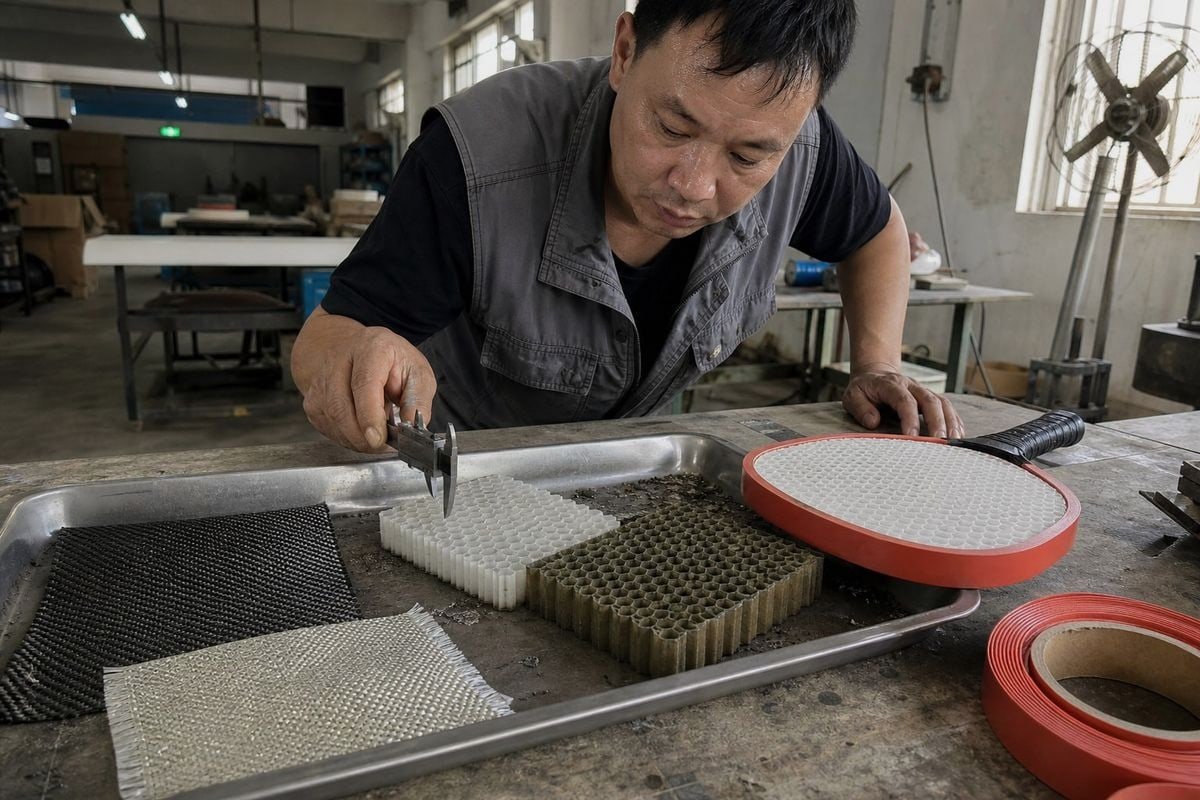
My personal rule when evaluating any quote is to look at two things before anything else: the paddle's surface material and the core material inside it. These two components drive both playability and cost, so they are where cheap quotes cut corners.
Face material: what the surface layer really costs
Fiberglass is the entry point. It gives decent pop but less control and lower durability. A carbon fiber surface adds stiffness, better ball feedback, and a raw, gritty texture players love. Raw carbon with a peel-ply finish sits at the top. Here is a trap worth knowing: cheaper quotes often rely on spray-on grit textures that wear smooth within weeks, while premium builds use peel-ply or laser-etched friction that lasts. Ask which one your quote includes, because both can be described as "textured carbon" in a sales email.
Core material and construction: the hidden half of the paddle
The core matters just as much. A 16mm polypropylene honeycomb core plays softer and more controlled than a 13mm core, and Gen5 PP cores cost more than older generations. Construction method creates another real price gap. Thermoformed, one-piece hot-pressed unibody paddles need more labor and specialized equipment than traditional cold-pressed builds, which is why they cost more. At our factory in Qiaotou, our one-piece hot-pressing line is the process our private label manufacturing 4 clients request most, because the sealed edges resist delamination.
Quality signals to demand in writing
- Resin-to-fiber ratio discipline. Low-cost suppliers sometimes use excess resin to hide layup flaws, which creates dead spots and inconsistent swing weight.
- Weight and balance tolerance. Ask for a stated range, such as ±5g, and ask how it is verified.
- Quality control inspection steps. Third-party inspections and lab-measured spec consistency justify a higher quote by reducing defective inventory risk.
- Sample verification. Pay the sample production cost and test the paddle yourself. A $50 sample can save a $15,000 mistake.
One more forward-looking item: some buyers now ask about vibration-dampening adhesives or quiet-core options as noise ordinances tighten in some markets. A supplier who can discuss acoustic engineering is usually a supplier who controls their materials.
What red flags should I watch for when a supplier's quote seems too good to be true?
The hardest lesson I learned early in this business came from watching a client rescue an order another factory had botched. His original quote was $3 cheaper than everyone else's. The paddles arrived with cores visibly crushed near the throat.
Red flags include vague material descriptions, missing MOQ disclosure, quotes that omit packaging or shipping terms, no stated QC process or weight tolerance, unrealistic lead times, and prices far below the normal band for the claimed material tier.
Some buyers argue that the lowest factory price should always win, and that you can protect margin by choosing an existing mold, simplifying graphics, and using standard packaging. That is a legitimate cost strategy, and I recommend parts of it myself. But there is a line between smart simplification and a quote that is cheap because something essential is missing. Here is how I separate the two.
Red flags versus reasonable explanations
| Warning sign | Innocent explanation | Dangerous explanation |
|---|---|---|
| Price below $6 for "carbon fiber" | Quoted at very high volume | It is fiberglass with a carbon-look print |
| No MOQ stated | Salesperson forgot | Price only valid at 2,000+ units |
| No packaging line item | Standard poly bag assumed | Retail box billed later as a surprise |
| EXW instead of FOB | Buyer arranges own freight | Inland freight and export handling shifted to you silently |
| No QC or tolerance mentioned | New salesperson | The factory does not measure anything |
| Extremely short lead time | Stock molds and open capacity | They will subcontract your order to an unknown workshop |
The apples-to-oranges trap
One comparison error deserves special mention. Consumer customization and factory OEM are different markets. Simple engraving on a stock paddle can cost under $10 extra at retail, while a full custom retail build often runs $100–$200 or more, with some platforms starting around $124 for a single paddle. If a "supplier" quotes you a per-paddle price that looks like retail customization pricing, they are likely a reseller decorating stock paddles, not a factory doing true private label manufacturing. Their lead time, quality control inspection depth, and scalability will not match a real production partner.
The final test is transparency on shipping and customs duties. A factory quoting DDP has priced in freight, insurance, and duties. A factory quoting EXW has priced in almost nothing beyond the gate. Neither is wrong, but comparing them side by side without adjustment guarantees a bad decision.
Conclusion
A fair price is not the lowest quote. It is the quote matching your spec, quantity, and materials at the lowest true landed cost. Compare five pillars: quantity-aligned unit price, design fees, mold charges, face material, and core material. If you want a transparent, line-by-line quote for your own brand, I am happy to build one for you.
Footnotes
1. The World Trade Organization provides definitions and context for international trade terms and pricing structures. ↩︎
2. Comprehensive Wikipedia entry explaining the engineering and properties of honeycomb core structures. ↩︎
3. Authoritative Wikipedia section covering official equipment standards and paddle specifications. ↩︎
4. Authoritative Wikipedia overview of the private label business model and manufacturing process. ↩︎