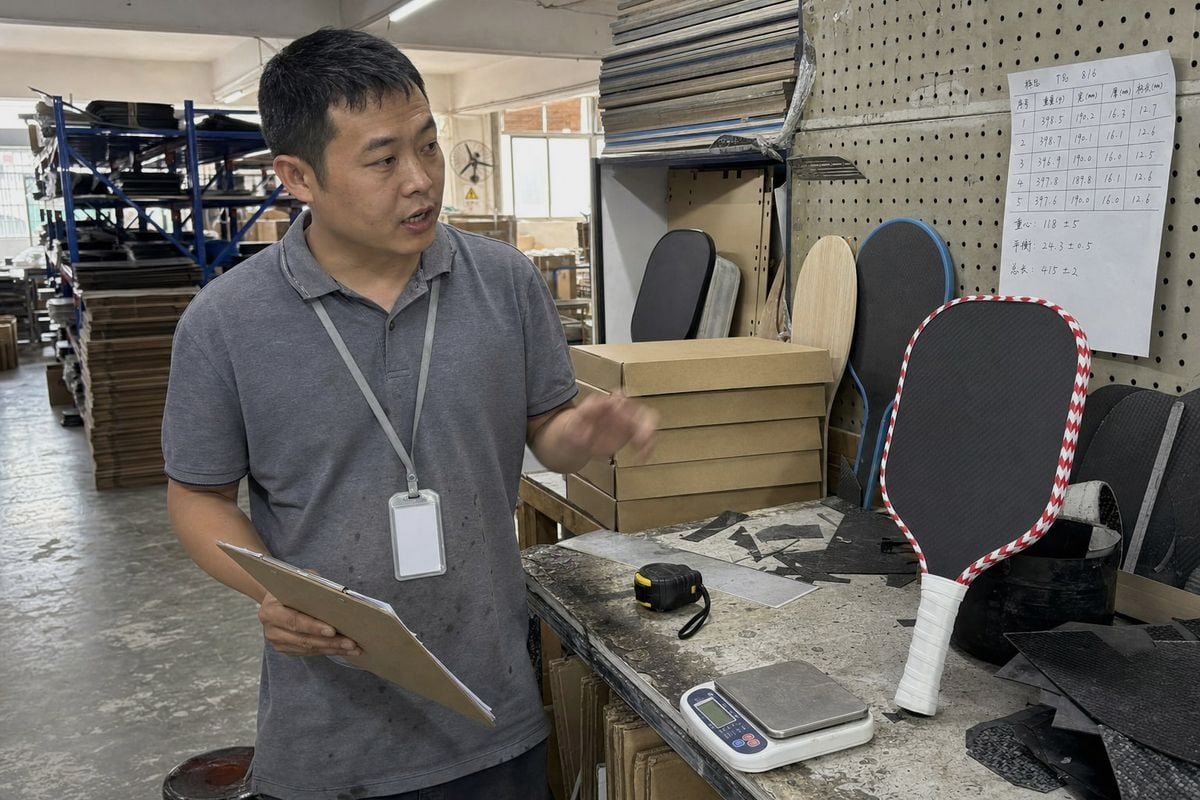
A product specification sheet for custom pickleball paddles can make or break your project vector artwork files 1. On our Dongguan production line, vague specs cause delays, wrong samples, and wasted money.
To create a product specification sheet for custom pickleball paddles, document the paddle shape, dimensions, core type, face material, weight range with tolerances, grip details, branding artwork, packaging, and USA Pickleball compliance targets. Add a revision number and approval sign-off so the factory can quote, sample, and produce accurately.
Let me walk you through each part of the sheet, step by step. I will use the same checklist we hand to new brand clients.
What Information Should I Include in My Custom Pickleball Paddle Spec Sheet?
A few years back, a buyer sent our team a single photo and the words "make this, but better." That one-line brief cost us three sample rounds. A complete spec sheet would have cost us one.
A complete custom pickleball paddle spec sheet includes product identification, paddle shape and dimensions, core and face materials, target weight with tolerance, grip specifications, surface texture, edge guard details, branding artwork, packaging requirements, compliance references, and a revision log with approval sign-off.
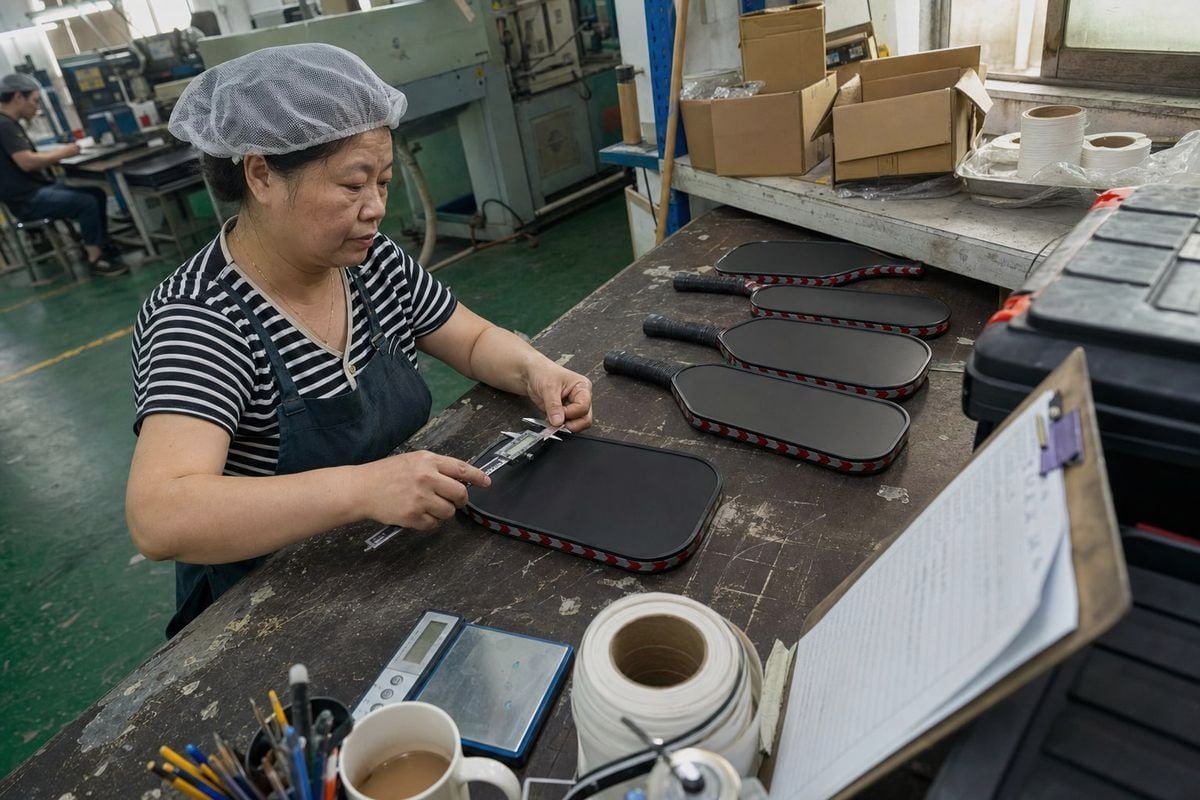
Think of the spec sheet as a manufacturing control document, not a marketing flyer. Its job is to remove guesswork. Every line should be measurable. If a factory worker in Qiaotou and a QA inspector in Manila read the same sheet, they should picture the exact same paddle.
Start With Identification
Put the basics at the top. Product name, model number, SKU, revision number, date, and target market. This sounds boring. It is also the section that saves you when you run three paddle models at once and revision five replaces revision four.
Choose the Paddle Shape First
Shape drives everything else. We build three main profiles for clients, and your sheet must name one clearly:
| Shape | Typical Size | Play Character | Best For |
|---|---|---|---|
| Elongated | ~16.5" x 7.4" | More reach, more power, smaller sweet spot | Singles players, aggressive hitters |
| Hybrid | ~16.3" x 7.7" | Balanced reach and forgiveness | All-around players, most brands' flagship |
| Widebody | ~15.7" x 8.0" | Largest sweet spot, best control | Beginners, control-focused lines |
Remember the legal limit. Length cannot exceed 17 inches, and length plus width cannot exceed 24 inches under USA Pickleball rules 2. State your tolerance, too. We recommend ±1/16 inch on face dimensions.
Then Cover the Rest
After shape, list your target weight (usually 7.8–8.3 oz for 16mm builds, with ±0.1 oz tolerance), grip length (5.0–5.5 inches), grip circumference (4.125 or 4.25 inches), core thickness, face layup, surface finish, edge guard style, and every branding touchpoint. Close the sheet with packaging specs, carton counts, and a QA acceptance section. I cover the technical and branding details in depth below.
Which Technical Details Matter Most When Specifying My Paddle Core and Materials?
The hardest trade-off we weigh in our workshop is spin versus durability. An 18K woven face grips the ball beautifully, but a T700 unidirectional face often survives more impacts. Your spec sheet must settle these trade-offs on paper, before we press the first sample.
The most critical technical details are core construction, core thickness, and face material. Specify the exact core generation or foam-composite system, a 14mm or 16mm thickness, the carbon fiber weave type, surface texture level, and required USA Pickleball compliance testing.
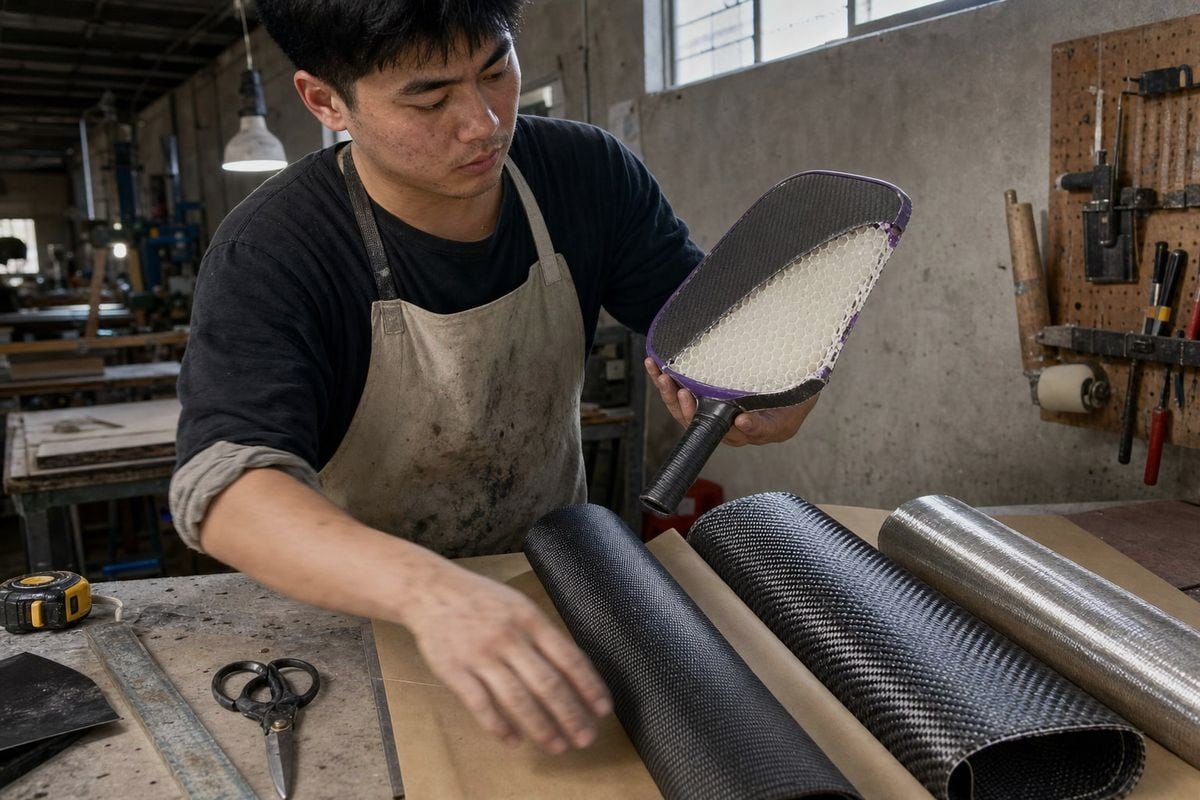
Materials are where most first-time brands write specs that are too vague. Writing "carbon fiber 3 face, polymer core" is like ordering "a car with an engine." Let me break down the real options we build every week.
Face Material Options
| Face Material | Character | Spin Potential | Price Tier |
|---|---|---|---|
| T700 raw carbon (unidirectional) | Stiff, consistent, durable | High | Mid-high |
| 3K woven carbon | Firm feel, classic look | Medium-high | Mid |
| 12K woven carbon | Softer flex, larger sweet spot feel | High | Mid-high |
| 18K woven carbon | Plush feel, premium positioning | Very high | High |
| Titanium wire weave | Extra stiffness and pop | Medium | High |
| Kevlar (aramid) 4 | Dampened feel, strong impact resistance | Medium-high | High |
Also specify the surface treatment. Raw textured carbon, sprayed grit, or thermoformed peel-ply each produce a different roughness. If spin is your selling point, reference the USA Pickleball surface roughness limit so your texture stays legal.
Core Construction Options
Core technology has moved fast. Our technical team currently builds eight core systems, and your sheet must name one exactly:
- Gen3 PP honeycomb — standard polypropylene honeycomb with thermoformed edges.
- Gen4 PP honeycomb — adds foam-injected perimeter walls for a larger sweet spot.
- Gen5 PP honeycomb — refined foam placement and hot-pressed one-piece construction for maximum consistency.
- EPP + EVA — full foam core, very soft and quiet, strong dwell time.
- MPP + EVA — mixed foam density, balances softness with rebound.
- EPP + blown carbon fiber frame — foam center with an air-molded carbon perimeter for stability.
- MPP + blown carbon fiber frame — firmer foam variant of the same structure.
- PP honeycomb + blown carbon fiber frame — honeycomb feel with a reinforced carbon rim.
State thickness clearly. A 16mm core gives control and a plush feel. A 14mm core adds power. Some of our catalog blanks use a 16/14mm dual-thickness build, thicker in the center and thinner at the perimeter. Finally, require sample approval and batch QC checks: weight, balance point, and a deflection test under a fixed load, so power response stays consistent across the run.
How Do I Communicate My Brand Design Requirements to My Paddle Manufacturer?
One of our Philippine clients, a woman of few words, once approved a sample over WhatsApp with a single message: "Red is wrong." She was right. The artwork file said "red," not Pantone 186C 5. Since then, our art department refuses any spec sheet without exact color codes.
Communicate brand design by supplying vector artwork files, exact Pantone color codes, precise logo placement dimensions, and finish requirements for every component: paddle face, edge guard, grip ring, grip wrap, and butt cap. Confirm the print method and approve a physical pre-production sample.
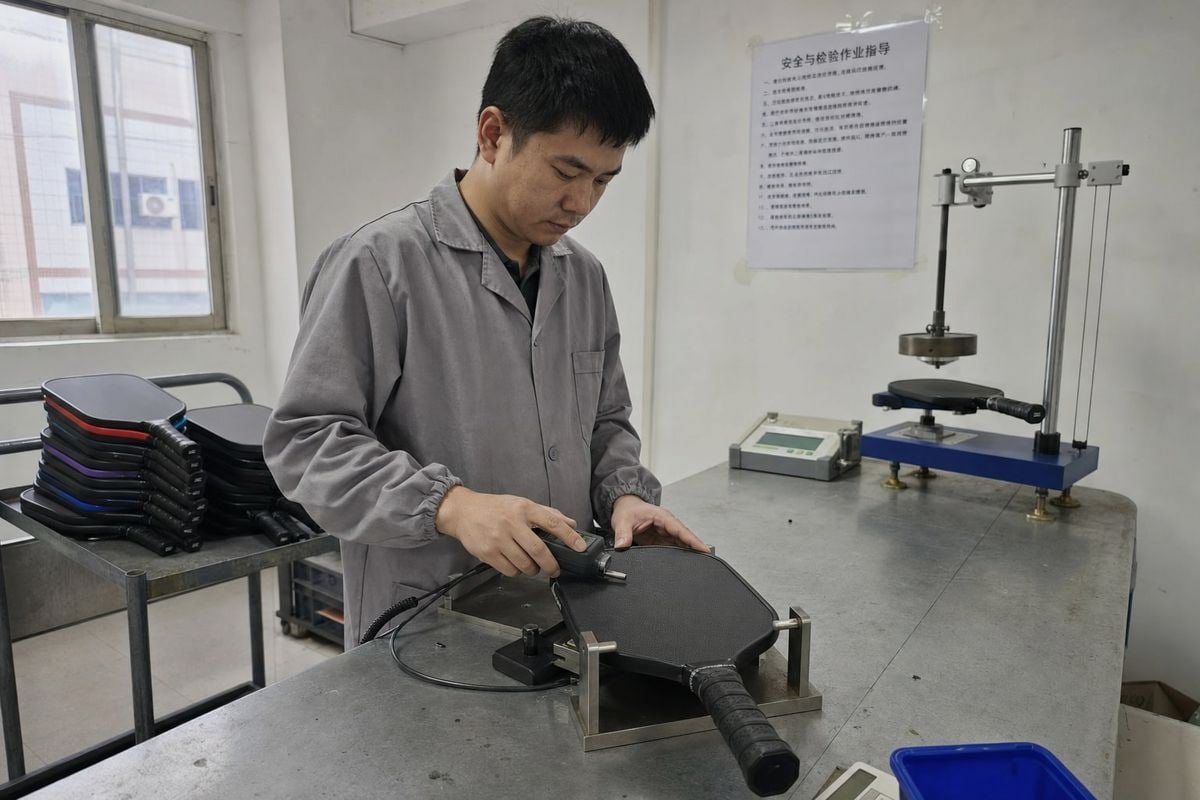
Branding covers far more than the face graphic. A paddle has five or six brandable zones, and each one needs its own line on your spec sheet. When we develop private-label paddles for brands in the US, Australia, and Southeast Asia, this table is the section clients revise most often:
| Component | What to Specify | Logo Option |
|---|---|---|
| Paddle face | Full artwork, Pantone codes, matte or gloss finish, print method | Yes — main graphics |
| Edge guard | Color, pattern (e.g., chevron), or edgeless design | Sometimes — molded or printed |
| Grip ring (collar) | Color to match or contrast the brand palette | Yes — small debossed or printed logo |
| Grip wrap | Color, texture (perforated, tacky, cushioned), thickness | Yes — repeated printed logo |
| Butt cap | Color, material, shape | Yes — printed or embossed logo |
| Retail packaging | Box artwork, barcode, insert card | Yes — full branding |
Artwork File Rules
Send vector files, AI or PDF, with outlined fonts. Raster logos blur when we scale them for UV printing 6. Include a placement diagram with measurements from fixed reference points, such as "logo center 40mm above the throat, 12mm tall." Words like "near the bottom" produce arguments. Millimeters produce paddles.
Print Method Matters
We match the print method to the surface. UV printing works on most carbon faces but can slightly reduce grit where ink covers texture. Many premium brands keep the hitting zone raw and print only near the throat and edges. Heat transfer 7 suits full-coverage designs on fiberglass. Your sheet should state which method you accept, because it affects both spin performance and cost.
Finally, always require a physical pre-production sample. Screens lie about color. A sample photographed under daylight, approved in writing, becomes your legal and quality reference for the whole order.
What Mistakes Should I Avoid When Writing My Pickleball Paddle Specification Sheet?
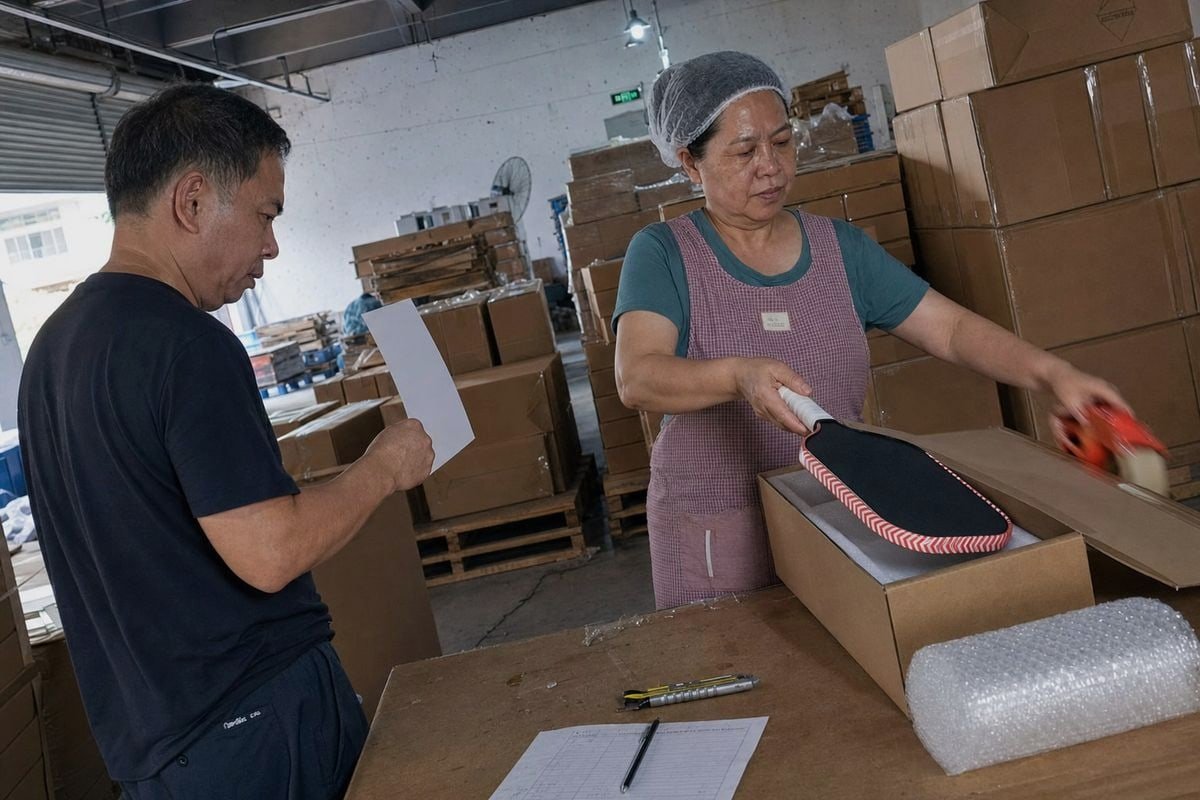
Over years of OEM development at our Qiaotou facility, we have seen the same handful of spec-sheet errors repeat across dozens of brands. Almost every delayed shipment traces back to one of them.
Avoid vague performance language without measurable targets, missing tolerances, no revision control, ignoring USA Pickleball limits, incomplete grip and component specs, and skipping written sample approval. Each of these gaps forces the factory to guess, and guesses create disputes.
Let me rank the mistakes by how much damage they cause, based on what actually crosses my desk.
Mistake 1: Subjective Words Instead of Numbers
"More pop," "lighter feel," and "better spin" are goals, not specs. Translate them. More pop becomes a 14mm core or an MPP + blown carbon frame build. Lighter feel becomes a target weight of 7.9 oz ±0.1 oz or a balance point moved toward the handle. Keep subjective language in your product brief. Keep only measurable requirements in your spec sheet. These are two different documents.
Mistake 2: No Tolerances
If you write "weight: 8.0 oz" with no range, you have written an impossible spec. Composite manufacturing always varies. Without a stated tolerance, you cannot fairly reject product, and the factory cannot confidently pass it. State ranges for weight, dimensions, and grip circumference.
Mistake 3: No Revision Control
Prototypes change after testing. If your sheet has no version number, the factory may build from an outdated file. Number every revision, date it, log what changed, and require sign-off before any new version enters production. One master document, one source of truth.
Mistake 4: Forgetting Compliance
If your customers play sanctioned games, your paddle must meet USA Pickleball equipment standards for dimensions and surface roughness. Check the current standards before you finalize artwork and texture. Our production is built around USAP-compliant standards, but the spec sheet should still reference compliance explicitly so testing is planned, not assumed.
Mistake 5: Ignoring the Small Components
Brands obsess over face graphics and forget the grip ring color, grip wrap texture, and butt cap logo. Then the sample arrives with default black parts, and everyone is disappointed. Specify every visible component, even the ones you want left standard. "Butt cap: black, no logo" is a valid and useful spec line.
Mistake 6: Skipping Written Sample Approval
Never let verbal or chat-message approval stand alone. Photograph the approved sample, attach the images to the spec sheet, and have both sides sign. That approved sample becomes the acceptance standard for mass production QC.
Conclusion
A vague paddle idea invites costly sampling loops. A precise spec sheet — shape, core, face, grip, branding, tolerances, compliance, revisions — turns your concept into a factory-ready, repeatable product.
Footnotes
1. Explains vector file formats required for scalable, high-quality UV printing on paddles. ↩︎
2. Background on the sport whose governing body sets paddle equipment standards. ↩︎
3. Explains the composite material used in paddle face construction described in the article. ↩︎
4. Wikipedia background on the aramid material referenced as a paddle face option. ↩︎
5. Official Pantone color reference matching the exact code cited in the branding example. ↩︎
6. Background on the printing technology used for branding pickleball paddle faces. ↩︎
7. General reference on the heat-based process applied for full-coverage paddle designs. ↩︎